What is meant by “product”?

In CMU-speak, a product can be a lot of things. It has a very broad, liberal interpretation, referring to anything artificial, material or immaterial, resulting from deliberative human effort and planning, not just a piece of hardware or physical gadgetry for sale.

A product thus, in this sense, can be any of the following:

  • A map
  • A poster
  • A physical object
  • A website
  • A software application
  • A network device
  • An electronic gadget
  • A user interface
  • A complex system
  • A web-delivered service
  • A business process
  • An environment
  • An organization
  • A course syllabus, even!

When you look at the possible range of what could be a “product”, you can see there’s an extraordinary range of possible arguments and forms of rhetorical communication, as well as methods of thinking to solve their inherent problems. Each of these product types is a potential argument requiring different ways of handling them and presenting them to people. It should also be apparent that each one of these product types embodies a flavor of interaction design thinking, how people engage with the product and leverage it given a particular context or purpose.

Again, there is nothing inherently digital or web-based about product design, or interaction design. Once you’re able to accept this and start from this place as your baseline, it frees up your abilities and approaches as a designer, imho.

Original design thinking* = Rhetorical thinking

* “Design thinking” has unfortunately become an overused buzzword, adopted by Silicon Valley digerati and strategy fashionistas to refer to solving problems in a “designerly” way. I hope to clarify the confusion, focused on the canon of design thought at Carnegie Mellon in the mid/late 90’s – early/mid 2010’s.

Proposed and advocated by Richard Buchanan — as drawn from Classical rhetoric and his studies with Richard McKeon at University of Chicago, with a lineage going back to John Dewey — the humanist, strategic view of design thought is essentially about communication and interaction among people, ideas, values, and cultures towards a deliberated resolution of “truth”.

What is rhetoric? It has unfortunately acquired an unsavory meaning, commonly seen as contrived double-talk or sly deception through verbal sleight-of-hand, associated with sneaky salesmen and unscrupulous politicians. However, rhetoric was originally an art of persuasive communication, dating back 2,000 years, first formalized by Aristotle, as a situated art (a set of disciplined, systematic connnections to ideas and methods, all operating in the background of one’s mind guiding their attitudes and behaviors). So rhetoric really offers strategies to shape people’s actions and thoughts via language.

Going further, a rhetorical act involves communication between a speaker and an audience given a particular set of circumstances and a focus of discussion, or topic. (ah, that notion of topos again, a place for exploration and truth-seeking) Thus the core elements that define a rhetorical moment or situation are: speaker, audience, context, and subject matter. There should also be a purpose, or goal for the speaker to accomplish. And naturally there is a method, or set of articulated techniques that shape the delivery and presentation of the speech to the audience, to elicit a variety of responses. This involves appeals made by the speaker to the audience’s sense of logic, emotion, and trusting the speaker as well, per their sense of character and judgment.

Unpacking this a bit more, a well-formed rhetorical act, or speech has three vital elements that constitute the argument put forth to the audience to interpret and respond:
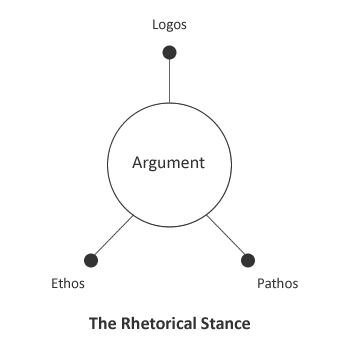
the rhetorical stance

Logos: the logical, rational reasoning behind the argument, based on facts, evidence, data

Pathos: appeals to the audience’s emotions and sympathies

Ethos: a presentational style, conveying the speaker’s voice, tone, and character as deemed to be trustworthy/credible (or note) by the audience

Giving the argument’s overall shape is a sense of purpose or goal, guided by the context or place in which the argument is being made, and of course the various methods employed.

So how does this all connect to design thinking? What are the qualities shared between rhetorical thinking and design thinking as advocated by Buchanan?

  1. Focus on human-centric communication, recognizing the totality of the human being that is addressed with the “speech” (or designed artifact, in this case), not mere one-dimensional users or tools to be exploited for narrow goals. Strongly socially-focused, either at the individual or collective levels.
  2. A situational perspective, taking into account the variety of elements and circumstances that shape the communication and color the audience’s (or customer’s) perception: context, activity, task, goals, other people in the situation, other artifacts that arise, etc. It’s not just the speech act (or design) alone in a vacuum but the holistic view of all the interrelated pieces impacting each other.
  3. An integrative approach, not a piecemeal or episodic way of dealing with problems. Looking at how the logical structure, emotional value, and human factors fluidly influence/inform each other. Each builds upon each other and should be viewed together, resulting in a fully formed solution.
  4. Conversation is key. Dialogue and debate arise through communication and interaction with the audience. There are no absolute answers necessarily. Iteration and evolution towards some commonly/consensually agreed resolution is the mainstay.
  5. There is a necessary, effective sharing across other disciplines, leveraging knowledge and experience from other fields, ideas, or values as appropriate to make the positive effect upon the audience. So, multi-disciplinarity is a core aspect as well.

The rhetorical stance (quote)

Wayne Booth, “The Rhetorical Stance” (1963)

The common ingredient that I find in all of the writing I admire (excluding for now novels, plays, and poems) is something that I shall reluctantly call the rhetorical stance, a stance which depends on discovering and maintaining in any writing situation a proper balance among the three elements that are at work in any communicative effort: the available arguments about the subject itself, the interests and peculiarities of the audience, and the voice, the implied character, of the speaker. I should like to suggest that it is this balance, this rhetorical stance, difficult as it is to describe, that is our main goal as teachers of rhetoric.

The product as argument

Another key tenet of CMU-style of design thought centers around this concept of shaping and delivering arguments, based upon rhetorical motives of effective, persuasive communication. If you treat your product as an argument, it provides a critical lens and systematic framework for deconstructing what you do as a designer. Not merely pushing pixels around or type, image, animations on a blank canvas to make something “cool” and “trendy” but a guided, deliberate, intentional act of communication that directs a person’s behavior and response. It’s not art, but a design act. A rhetorical moment choreographed by the designer’s vision and goals, much like an orator/speaker.

An argument (in the rhetorical sense) has a basic set of three pivotal elements: logical structure (logos), human emotional response (pathos), and the presentational style or voice of delivery (ethos). Held together in balance of emphasis where neither one of these three overpowers the other (known as the rhetorical stance, from Wayne Booth), an effective argument is formed and executed by the speaker.

the rhetorical stance

The relationship to design is apparent, if you consider a product like an iPod or Google’s search page or Dyson’s vaccuum cleaner as an argument. Not a work of art, not cool form, not mass-produced consumerism. As an argument: Its mechanical and operational abilities must function in concert with the emotional response, human affordances, usability/human factors, as well as with its brand, styling, colors, imagery to constitute a well-formed argument that draws the customer in, compelling her to purchase and use the product in her daily lifestyle as appropriate.

In essence, the argument (product) must be deemed useful, usable, and desirable–the invaluable holy trinity of design success! That success is most likely achieved when there is a proper balance of the elements (logos, pathos, ethos) that make up the argument. Engineering, human factors, brand/style must all work in concert effectively without any one overpowering the other. When something is heavy engineering, it’s too “techie” and over complicated for targeted users. When something is driven by usability concerns, it lacks elegance, beauty, aesthetic character which enliven a person’s life. When something is overly stylized and expressive, it becomes frivolous and useless, or even makes a mockery of basic functionality.

Each product is a form of communication that speaks out to potential customers, in subtle and unconscious ways, via the semantics of use, visual signals, formal affordances, and mechanical abilities (ie, features), as well as overal appearance and fit for the user’s situation or context.

Each product is an argument delivering a multi-pronged reason or set of appeals to persuade somebody to use it and enjoy it.

Ultimately, this rhetorical balance (the well-formed argument) is the central task of the designer: to envision and create products appropriate for human situations of use, drawing upon whatever knowledge is needed to get the job done.

There is no perfect design

This pithy phrase may seem like a defeatist, cynical dismissal of product design reality, but it actually refers to the title of a noteworthy book written by Henry Petroski, the brilliant and instructive structural engineer. Everyone should read that book! It is also one of my favorite tenets as a designer, as it speaks to the very nature of designing, particular in complex multi-disciplinary situations.

Design operates amid a complex milieu of opinion, politics, argument, ego, power, control, ego, and of course limits: budgets, resources, timelines. Not to mention competing and often conflicting (or contradictory) priorities held by various departments like QA, Engineering, Customer Service, Documentation, and Human Factors. (the core elements of a product’s lifecycle)

In order for the designer (and rest of the team) to preserve their sanity and achieve shipping goals so as to produce a product that generates meaningful revenue/profit, everyone has to recognize that a design is never 100% perfectly done and is always open to discussion and improvement, due to all the various perspectives and stakeholders. From the smallest tweak to the greatest strategic alignment, improvements are always possible to make it “more perfect”. The challenge is deciding when the design is considered sufficiently ready for sale and use. Product lifecycles cannot continue infinitely iterating…

This relates to something Steve Jobs famously said: “Real artists ship”. It’s not about achieving perfection, whatever that concept means. Who decides what is perfect anyway? Users? The designer? The product manager? The CEO? That’s a whole other discussion about organizational decison-making and political cultures, power structures, etc. Whew…

Back to the topic at hand, in the world of software development, in particuar, there is always a version 2. Tough choices have to be made to ensure a version 1 actually ships. And those ideas that didn’t make the cut the first time around (based upon criteria consensually agreed upon by designer and PM and Dev leads) can still inform the next iteration. This is also related to the issue of dealing with edge cases. There is no perfect design. No design will satisfy 100% of users’ needs. No design will pass all usability tests perfectly. You can’t please everyone all the time.

The sooner the designer and the entire product development team (and their respective allies) accept this truth, the better off everyone will be in making the necessary choices upfront to better secure and sustain productive (and happier) design efforts over the long-run.