Figuring out “service design”

Update: Fellow CMU alum Jeff Howard has compiled an excellent literature review of articles largely from business journals (HBR, etc.) regarding Service Design. Highly recommend!


So I’ve spent the last 7 years entrenched in the field of “user interface design” or “interaction design”, focused on creating good digital UI’s for web/mobile/desktop software solutions at a wide range of companies (from Oracle to Adobe and Cisco to studios like Frogdesign and Involution). Lately I’ve started to wonder what’s next…is there “post-UI” design? If so, what is it? Possible answer: service design.

Coming from Carnegie Mellon, arguably one of the birthplaces and pre-eminent advocates for service design, I’m already fairly familiar with this concept (see Buchanan’s Four Orders model), but I’ve decided lately to look even deeper into it. And given where things are moving in terms of software design (SaaS, like Salesforce), RIA’s (AIR and Flex apps), cloud services (Amazon web services), convergent products blending UI with service (iPhone + App Store, GPS units, In-car telematics, net-enabled home appliances), I’m sensing that designing for services is the Next Big Thing for UI designers. Indeed, Robert Brunner keeps pushing this angle of designing for the “total customer experience supply chain” to achieve a positive emotional connection with users that will enable a designer’s existential relevance and value to the business. Hmmmm! Sounds like a “service design” POV…?


Initial readings
– Dan Saffer’s Designing for Interaction (particularly the chapter on Service Design)
– John Thackara’s In the Bubble (particular the final chapter on Flows)
– Malcolm McCullough’s Digital Ground
– Various web postings by Shelley Evenson, Jeff Howard, Jamin Hegeman, et al (I don’t think it’s a coincidence they’re all from CMU’s School of Design :-)


Overall summary

(In my view…) Service design is principally about the choreography of situated moments of customer & business activity as a structured sequence (or process) across multiple physical and digital “touchpoints” (ex: signage, logo, store rep, phone call experience, customer service, packaging, instruction manual, website, etc.) which constitute a “service string” or “customer journey”. The key term here is “choreography” which implies a dramatic or theatrical quality of enactments of people over time. The people are bi-lateral/2-way participants in the service exchange (experience), involving both the customer (end user) and the business (sales agent, for example) in a co-creative activity. It’s all about the CONTEXT or ecology of moments, which includes: people, objects, processes, and environment (not sure if this means “surroundings” or “active sphere of space/place directed towards the user’s goals” in the Deweyan sense…)

Designing a service, sounds to me, strongly related to the business model of a company and how that is reflected into the brand and the brand’s embodiments (website, ads, logos, giveaways, call center hotline, etc.)…indeed it seems designing a service = designing a business! You’re not just “making a website” or “a piece of software” but trying to solve the problem of a) an unmet/undiscovered customer need, b) unmet business goal or expansion of business plan and thus ultimately deliver “customer value” via this well-defined, choreographed “customer experience supply chain” (per Brunner). Sounds a bit Dilberty I admit, but this relation to business model design and fostering/delivering value is I think the core…and what makes Service Design so compelling, beyond pixels and code. Indeed, service design speaks to how such pixels/code can “serve” the business strategically.

Also, service design is very intangible–you can’t touch a service or point to it (except perhaps the activity being performed in real-time). Yet the service has tangible manifestations like a website, brochure, credit card, ticket, kiosk, etc. Those “traditional” UI skills are still needed, in demand, but wrapped by a broader set of concerns and a far-reaching outlook that gets more directly to the business goals.

It is important to point out that service design inherently has a dimension of systems design to it–far-reaching consideration of the broad levels of impact across industries and channels and stakeholders. The two go hand-in-hand, as Shelley Evansen says, “there’s often design of systems of systems” with nested or sub-levels of systems identified and mapped out.


Who can benefit from service design?

Lots of industries (and their customers) actually: healthcare, financials, retail/merchandising, hospitality (restaurants/hotels/clubs), education, government, transit systems, telecom, entertainment/gaming/media. And in this depressed economic climate, the industry that could hugely benefit is green-tech/energy services…! Hmm.


What are some examples of service design in action?

It’s important to note that this is not simply empty Dilberty corporate-speak and hand-waving… There are specific material examples with ample positive results rolling out. Service design may not have the same immediacy of a website or software patch released overnight, but the impact is certainly felt over time and across environments.

* US Postal Service
* Mayo Clinic
* Acela & IDEO
* MTA Metro and JetBlue kiosk


Who’s doing this stuff?

* 2nd Road
* Live|Work
* IDEO
* Doblin
* Jump
* Engine
* Design Thinkers
* Peer Insight
* 31 Volts
* Inland Revenue New Zealand

More examples coming soon…
Aesthetic integrity

Just saw this from the Apple iPhone Guidelines about “aesthetic integrity”:

Aesthetic integrity is not a measure of how beautifully your application is decorated. It’s a measure of how well the appearance of your application integrates with its function. For example, a productivity application should keep decorative elements subtle and in the background, while giving prominence to the task by providing standard controls and behaviors.

An immersive application is at the other end of the spectrum, and users expect a beautiful appearance that promises fun and discovery. Although an immersive application tends to be focused on providing diversion, however, its appearance still needs to integrate with the task. Be sure you design the user interface elements of such an application carefully, so that they provide an internally consistent experience.

Nicely said, imho :-)

Jean Nouvel on design & architecture

Just found this while browsing through a recently acquired (like, this evening!) collection of old AXIS magazines, dating back to 1992, from a neighbor moving out and getting rid of stuff. AXIS is a fabulous Japanese magazine of design, art, architecture, featuring heavy paper stock and gorgeous photography, as well as deep interviews. Below are some quotes from an interview with Jean Nouvel, the French architect/urban planner:

Design is a question of essence; and at the same time it is also a question of exigency.

Architecture too is one of those cultural witnesses that give expression to the structures of feeling of its time. But in the case of architecture, there is a certain eternal quality of buildings as such. It is not possible to erect meaningless things. There is nothing wrong with objects created for a particular place, for someone’s collection. However, architecture must be equipped with ‘qualities’.

When I design architecture, I imagine where people will go once they have entered the building and what their pathways through the building will be like. The continuity of scenes that people pass through in a building is like the sequence of scenes in a movie, and that’s how I think about architecture. It’s all like framing in the movies.

Good inspiration for designing digital interactions!

Part 2: Interpretations of beauty as a value of user experience

[Second in a series of postings about aesthetics and beauty as they pertain to interaction design, and beyond…]


When we think of beauty, certain things come to mind: art, nature, physical and sensual qualities of the human body. But what about the artificial or digital, those interfaces/services/systems that are conceived and planned and designed by multi-disciplinary teams? Is it sensible for a digital UI or consumer product to be characterized as beautiful in the same way as a painting or a flower? Doesn’t that depend upon the relation between the user and the value of the user’s interaction (i.e., experience)? Indeed, how should one articulate beauty in terms of design, supportive of technology and business aims, driving new product development enriched with this sense of beauty, or aesthetic imperative? This hints at the broader issue of interpreting beauty as a matter of user experience.

But what is meant by experience?

I propose that experience involves a subjectively interpreted, continuous stream of psychological and physical phenomena brought into awareness through an interaction or communication. This depends upon the following elements:

• The relationship between a person and an object
• The process of being drawn to that object and engaged on multiple levels: physical, behavioral, and emotional
• The value that arises from the attractive encounter

These elements may be labeled as attention, attraction, and beauty. So beauty—an emergent value of human attention and emotional attraction—enables designers to plan and craft products that offer a rewarding, memorable encounter.

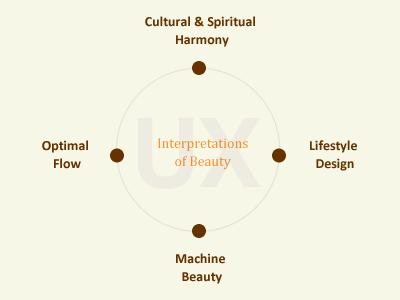
I offer a framework to provide ways to understand beauty as an experiential phenomenon, arising from user/product interactions. What follows is a set of interpretations of beauty based upon the writings of John Dewey, Mihalyi Cziksentmihalyi, David Gelernter, and Walter Gropius (philosophy, psychology, computer science, and architecture, respectively).

beauty_model.png


This model is a tool to guide discussions for interaction designers about a product’s aesthetic value, centered upon user experience thinking. This is not a statement of a grand unified theory for all beauty or aesthetics in nature, but only focused on “the artificial” or human-made artifacts. Please note that no one interpretation is preferred, nor are they exclusive of one another in evaluating a product as “beautiful”. It’s not about being “right” or “wrong” or “better” or “worse”…It’s about expanding our vocabulary and ways of looking at the problem of beauty in terms of interaction and experience.


Optimal Flow

Csikszentmihalyi is a psychologist who regards human-product interactions as a pathway to personal achievement amid daily concerns for speed, efficiency, and materialism, which may engender a disconnected way of life. His theory of optimal experience—or flow—is predicated upon self-directed efforts to focus one’s attention. This concern for attention suggests useful design possibilities. Using Csikszentmihalyi’s language and approach, one may consider designed artifacts as systems of interaction, whereby the invitation to participate evokes a harmonizing response. The artifact expresses its “rules of engagement” of how to approach and use an object through its form, all directly perceived by one’s attention. Such rules may include the visual semantics and product affordances that convey a manner of use. Thus, these rules shape the experience, or attractive relationship, between the user and artifact. The user subsequently enters a process of participation in which flow conditions may emerge, if there is a suitable matching of goals, skills, and feedback for the user. The proper balance enhances the utility, usability, and desirability of the product overall.

Lifestyle Design

John Dewey was a pragmatist philosopher focused on the process of interaction between a conscious being and her environment—the “sustaining or frustrating” conditions that define the activities of a person, such as the tools, spaces, materials, or other people. Dewey shifted the emphasis of interaction from a reflexive communicative exchange—such as flow—towards an outward relationship of growth and renewal. Every experience has a structure and pattern, found in a rhythmic “doing and undergoing”. Dewey was especially concerned with recovering aesthetic experiences, which feature a dynamic integration of thought, action, and emotion into a unifying whole, that he termed “an experience”. Dewey avoided the term beauty due to its Romantic origins, but he pursued what may be construed as experiential beauty—a harmonious balance of the maker’s intent and the perceiver’s expectations towards a meaningful consummation of movement of emotion from inception, carried through development, and ending with an artifact that lives in experience.

Machine Beauty

For computer scientist David Gelernter, “machine beauty”—the union ofpower and simplicity in innovation—is key to developing products that helps users “break free” from the confines of a machine’s internal logic towards a “creative symbiosis” between the user and her activity. In other words, the device should be an extension of a user’s intention to accomplish a task, like stapling papers, dialing a phone, washing clothes. A loss of awareness of the structure and mechanics results, leading to a direct engagement of the material, akin to Cziksentmihalyi’s “illusion of disembodiment” and a singular unity of being. However, such beauty does not live in the environment of one’s lifestyle or absorbing one’s attention but in the execution of the logic of the product’s functions in relation to a user’s activities. Does the product enable her to perform her task, so that it does not become the burden her attention? To achieve functional elegance, there needs to be a transparency of use and directness of effect, turning the product and ensuing experience into something simple yet empowering.

Spirital & Cultural Harmony

Finally, the fourth interpretation of beauty takes a holistic look at the relationship between a user and her product and how that impacts personal beliefs, cultural values, and even a sense of “spirit”. This is drawn from Walter Gropius’ idea of a “scope of total architecture”. Gropius, was the influential founder of the Bauhaus, based upon principles of integrating art and design, to inspire industry with clean, rational forms. Gropius described his vision of design planning as “the art of coordinating human activities towards a cultural synthesis,” a reunification of the self with the natural environment, beyond the perils of mechanization. Amid the “atomizing effects” of an increasingly mechanized society, there is a segmentation of human lives. Therefore, Gropius’ approach sought to achieve balance, order, and unity within one’s life, collectively and personally. There is an internal movement that connects a person to something greater than herself, perhaps ideals that speak of a cultural synthesis. She may feel like a member of a community that elevates what has been experienced into something personally intimate yet outwardly relating to a collective whole. To design products that inspire the human spirit and awaken cultural connectedness is a powerful variation of experiential beauty.


Aesthetics for Interaction Design

Part 1: General thoughts on design aesthetics

Part 2: Interpretations of beauty as a value of user experience

Part 3: Towards an integrative aesthetic experience

Part 3: Towards an integrative aesthetic experience

[Third in a series of postings about aesthetics and beauty as they pertain to interaction design, and beyond…]


So what then is the result of this investigation into beauty, as a value of user experience and beyond? In terms of pragmatic product development, where the designer must collaborate and communicate with non-design peers leery of “flowery prose” extolling beauty’s worth (“What else is new”, yawns the jaded engineer), what’s needed is a simple yet powerful framework that builds upon what we already know. This framework must provide a straight-forward vocabulary and un-compromising attitude about what’s most important.

What’s also needed is a re-positioning of beauty from simply surface veneer towards a cumulative or “integrative” aesthetic whereby the core elements build upon each other to yield something engaging, memorable, and thus deserving of repeat purchase or glowing customer testimonials. Aesthetic implies a totality, a whole, that also speaks to the whole human being, not just “users” objectified for a study or reduced to a data point: issues of respect, desire, freedom, interaction, etc.

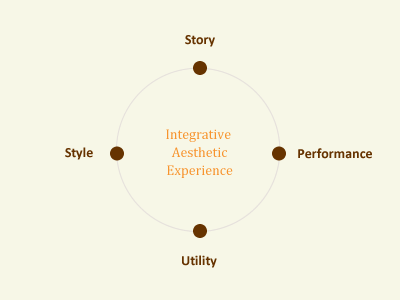
I propose a movement towards creating and delivering the “integrative aesthetic experience”, as a way to target product development efforts around human goals that will lead to better products, happier customers, and increased business, etc. This idea is based upon the following framework:

iax_model.png


These are the core elements of an aesthetic experience expressed in simple practical terms that can be used with PM’s, engineers, managers, but keen readers will note their mapping to Classical rhetorical terms that constitute the balance. The following is a breakdown of each element with the Classical term in parens.

Story (mythos): The narrative or scenario of use for this product, and how it suggests a positive, beneficial user experience or service for the targeted customer. Also, how does this offering fit within the portfolio of products/services by the company. What’s literally “the story” for this, as communicated by marketing and supported by the product’s functionality, to fit the user’s needs and goals?

Style (ethos): The sensual/visual voice expressing quality of the product, and the overall brand in a way that supports the business, distinctly portrays the product, and fits the user’s “gestalt” of the company, context of use, needs/wants. High style is valued by today’s customers for various psych and emotive reasons.

Performance (logos): The technical ability of the product; its functionality and durability for the targeted market and usage scenarios. High performance, anytime/anywhere, 99.9999 uptime, rapid updates and on-the-fly responsiveness all convey this quality.

Utility (pathos): The general usability and utility of the product’s features for a specific audience and context. Is it ergonomic, culturally appropriate, psychologically meaningful. Are the affordances easily conveyed? Is it accessible and standards-compliant, etc.

With these simple terms a product development team can:

– Map core elements that relate to their team function and role (for example, Engineering & QA in charge of performance, Marketing shapes the brand story, User Experience guides the style and utility).

– Shape a meaningful dialogue about the product around specific anchors, instead of loosy-goosey vague wording and hand-waving, there’s something specific to point to and someone can take ownership of (for example, Does the story enhance the overall company brand? Who can improve that? etc.)

– Establish basic criteria for internal evaluation, a 1-10 rating perhaps for determining go/no-go decisions, judged according to each of the four elements (for example: story is a solid 10 but the performance is meager 5, while the style is only a 2, etc.)

I think what makes this framework powerful is its use of simple clear words anyone can grok fairy reasonably and easily. Managers and engineers “get” what style, performance, and utility are all about. PM’s often argue about “what’s the story” for a certain feature when preparing their PRD or MRD requirements. These are not alien terms or “flowery prose” but ordinary concepts that map to something quite extraordinary and powerful for the designer seeking to achieve beauty in design, regardless of the final form: an interface, a device, a service, etc.

Aesthetics for Interaction Design

Part 1: General thoughts on design aesthetics

Part 2: Interpretations of beauty as a value of user experience

Part 3: Towards an integrative aesthetic experience