
What’s wrong with UCD?

Nothing, as long as you approach UCD (User-Centered Design) as an over-arching philosophy and general framework for considering people in the design of a product, in addition to all the other concerns. Held lightly in the mind as a “mode of thought”, UCD can be very useful in helping those who are engineering-centric or accounting-driven to broaden their perspectives and take into account other priorities and values as well as the mainstay of features and profits. In other words, the priorities of people, the actual users of the product, become a primary focus with the other critical issues. Of course, there is no one “end all, be all” UCD definition, or method, or diagram, or pledge of allegiance, or anything like that. It’s all exceptionally diverse with multiple flavors used by different companies/designers, but  bound by an overall premise: people matter.

In my view, UCD is really just about taking the product’s users into account, balanced with business and technical concerns, along the lines of the rhetorical balance. Interpreted through the lens of shaping an effective argument, UCD activity should really be a deliberative process of discovering the right balance of trade-offs, constraints, priorities, and values when collaborating with product managers, engineers, marketers, and other participants in a highly complex product development process.It’s not about the primacy of one “UCD method” versus another “UCD method”, or the centrality of a specific user research deliverable over all else (much of which should be taken with many grains of salt anyway) and taken as “starter fodder” to have something to work with.
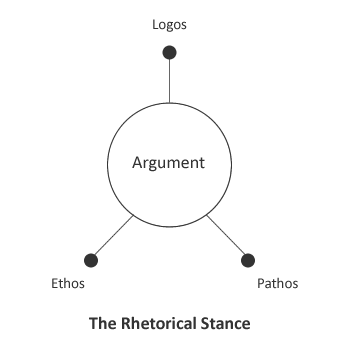
However, there is great discussion in various circles about the semantics of the term, with focus on the actual literal meaning of the specific words (e.g., user centered design) as being exclusive of business and technical concerns. It’s a fair point to argue as many do on ixda for instance…perhaps creating more confusion along the way :-) As purely a label, it just seems to me that UCD has become a de facto, commonplace, accepted phrasing used in conversations with business and technology leaders. The phrase has gained traction across the high-tech industry, design academics, new design graduates, and so forth. There’s a general gist of what’s meant by it that most people grasp well enough. That’s mainly why I have accepted the label and simply moved on; besides, I’m too busy designing to worry about what to call the damn thing :-) The bottom line is that designing something involves multiple centers regardless; the trick is how to balance them altogether…

What we need to be clear on is what UCD is NOT:

  • UCD is not simply “giving what the user wants”; designers are NOT short-order cooks and most folks have no idea what they truly want (beyond vague phrases like “make it simpler, easier, intuitive, get rid of all the buttons, bigger icons, etc.”), or have difficulty expressing their desires accurately
  • UCD is not a commodotized recipe for an “easy to use” design; just like any design activity, there’s iteration, fast-failure, re-visiting issues, and yes mistakes do happen!
  • UCD activity and decision-making should not be ignorant of other concerns (business, technical, etc.)
  • UCD is not a panacea that will fix all problems; product design problems are often way more complicated than simply “what’s best for the user”, often requiring inputs and trade-offs with various departments, teams, professionals, etc.
  • UCD is not an exclusive, guaranteed approach. It is one approach to design that is best taken with several grains of salt, and perhaps better when mixed with other approaches (Activity-oriented, “Genius”-oriented, etc.)…The master designers know how to tactfully blend, which comes with years of experience of course.

What’s still perplexing for many folks is how to account for supposedly “non-UCD” successes like the iPod, iPhone, Dyson, Michael Graves collection at Target, etc. (Although you can argue that people were considered at the forefront of the designers’/engineers’ minds, just not in a regimented, exclusively method-centric fashion). Perhaps what’s needed is a better understanding of UCD thought & practice framed as just one part of a much greater (and complex) product development effort, as I suggested above… More on this soon.

Change vs. Experience

Surveying the rhetoric by the candidates vying to be the next president, two major themes emerge: change and experience. Each of the major candidates are trying to position themselves as embodying or representing one of those ideals. Hillary = Experience, while Obama = Change. McCain = Experience, while Romney/Huckabee = Change. But regardless of personal political affiliations and favorites, I can’t help but think as a designer that these themes are exactly what designers struggle with daily with clients and projects. Change and experience are simply inherent to design.

Change is fundamentally what design is all about, in my view. More accurately, positive change, for the better. As Herb Simon declared in what has come to be regarded as a canonical work of modern design theory The Sciences of the Artificial, “everyone designs who devises courses of action aimed at changing existing situations into preferred ones”. In this regard, designers are quite simply “change agents” in the conception, planning, and creation of solutions that help people. There are of course levels of change and impact, depending upon the contingencies, constraints and circumstances that define a given situation, or the scope of it. A change may involve the decision to use a different typeface as the corporate brand (see Apple), or commercializing technologies that support fluid, direct manipulation (see iPhone and Wii), or reshaping the entire business model with user participation (see Netflix or YouTube). There is change of the artifact itself, and of course change of user behavior and attitudes, towards a more positive user engagement and thus purchase/referral/repeat usage, favoring the business cycle. Darrel Rhea of Cheskin suggests there is a “continuum of innovation” from incremental improvements, to evolutions, to inventions, to entire industry transformations, that represent different fields of opportunity for designers.

Experience means a couple things for designers. There is of course the extensive background knowledge and past experience from prior clients and projects that help evolve a designer’s competency to shape/drive a vision in later situations. This kind of experience is an ongoing learning process, natural and necessary for future success. And there is the concept of designing to improve a user’s quality of experience or engagement, between himself and the “other”: product, service, system, environment, etc. It’s a complex milieu of psychological, phenomenological, and emotional issues/materials. Designing to improve the user’s experience has become a paramount goal for all designers, regardless of the resulting artifact, whether a poster or a system. Thinking about the quality of that engagement is a critical consideration when designing, in addition to the craft aspects of the artifact.

Finding a designer who has the experience to make change, that is hugely valuable! Such person must simultaneously hold passionate idealism, yet be able to arbitrate the practical realities of a situation, taking pragmatic courses of action to enable the ideals to manifest successfully in a realized form one can be proud of. To me that’s a powerful ideal to strive for, and perhaps the hardest to achieve as designers seeking to improve the lives of ordinary people.

Quote of the day

From Vlad Margulis, UI Designer at Google:

Just as speed doesn’t define the essence of a jaguar, but merely represents a trait that evolved for its survival, intellect doesn’t define the essence of a human being. The essence of humans is the depth and range of emotions with which we experience our interactions with the world.

When starting a project

Key things to focus on at the beginning of a new project:

1. People:

  • Identify all the key players, get their contact info (email, phone, IM) and their physical location/time zone too
  • Get their schedules of availability for this project, including days they telecommute (WAH)
  • Identify the official decision-makers and approvers: technical, business, design (tech = engineering + QA leads)
  • Identify the role of other people involved (contributor, informed, etc.) and who to expect might pop-up down the road
  • As the project evolves and scope is re-defined (which always happens!), more or different people will enter/exit as needed, adjust as necessary

2. Process:

  • Decide the working style and process
  • Decide whether to do in-person, phone conf, web conf, etc.
  • Decide level of day-to-day involvement
  • Make sure all in agreement, with room for adjustments down the road

3. Deliverables:

  • Decide what the final deliverables will be and how success will be measured/identified
  • Decide what the working/interim deliverables will be and how they will be reviewed (see Process above)
  • Make sure all in agreement, with room for adjustments down the road

4. Schedule:

  • What are the deadlines and milestones? What is expected at those points in time?
  • Make sure all in agreement, with room for adjustments down the road

5. Materials:

  • Gather the latest version of critical documents as fodder/material for analysis and discussion
  • MRD, PRD, ERD: all technical and business requirements
  • User Research: all personas, scenarios, use cases, taskflows, architecture or concept maps that have been done already even in preliminary form
  • Prototypes, if any
  • Screenshots, specs if any, and photoshop files
  • Latest builds, if any

What is design?

From various notable personalities in the design world, collected altogether…

“In essence, design offers a pathway for bringing theory–ideas bout the nature of the world and how we should live our lives–into closer relationship with practical action and the creation of diverse kinds of products and experiences.”

— R. Buchanan, Design and the New Rhetoric

“Design is the art of causing change to occur in accordance with taste and intent”

— Clement Mok, Time for a Change

“Design is the method of putting form and content together. Design, just as art, has multiple definitions; there is no single definition. Design can be art. Design can be aesthetics. Design is so simple, that’s why it is so complicated.”

— Paul Rand

“Design is a plan for arranging elements in such a way as best to accomplish a particular purpose”

— Charles Eames

“Design is the fundamental soul of a human-made creation that ends up expressing itself in successive outer layers of the product or service.”

— Steve Jobs

“To design is much more than simply to assemble, to order, or even to edit; it is to add value and meaning, to illuminate, to simplify, to clarify, to modify, to dignify, to dramatize, to persuade, and perhaps even to amuse.”

— Paul Rand