Updated my site with Issuu

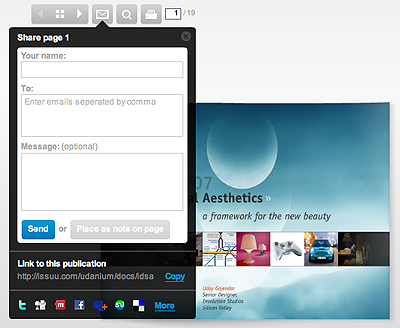
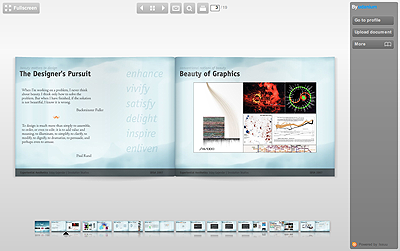
I just updated my personal site, the Papers section, with a nifty Flash-based technology from Issuu, which enables PDF files to be viewed directly in the browser via a rich, smooth interface. No more interruptive and annoying dialog boxes asking to download, etc.

If you do want to download a PDF, just use Issuu’s nifty tools for emailing, sharing, and copying the exact file URL.

Below are a couple screenshots as a preview. Enjoy!

issuu_example.png
issuu_example_2.png

On becoming a design leader…

This is based on a talk I gave at IDSA a few years ago, which I re-delivered to my class recently.


As the fields of “web design” and “UI design” speed forward into a complex world of integrated, convergent digital products (see iPhone, TurboChef, Tivo, TomTom, etc.) with arrays of “cloud services” and “suites of functionality” (like enterprise e-business software or even consumer suites: iLife, Creative Suite, etc.), designers need to offer more than just pixel-pushing and spec-writing skills. Indeed, more than ever, design leaders are needed who can assert a strategic view of designing compelling digital solutions. What does this mean?


1. Designers must be adaptive humanist leaders.

Let’s break this apart:

Adaptive means being nimble, flexible, amenable to constantly changing biz & tech requirements (and seeking out user requirements from the field), yet preserving the integrity of the original design vision (ie, the value proposition).

Humanist refers to the empathetic nature of a designer, to be totally aware of the human condition of designing a total experience, from start to finish. This refers of course to empathy for the user, but also for the engineers, marketers, and other members of complex teams with competing goals/values.

This rolls into then next keyword, leader. A designer has to make decisions, and lead with confidence about their vision for a great solution to often difficult problems. To be a leader often requires compromise, negotiation, diplomacy, and persuasive communication skills…as well as a powerful vision embodied in your sketches, designs, prototypes.

2. Designers should be like ecologists, conscious of the integrated system of invisible consequences.

Every product/service needs to be viewed as part of a system of platforms, hierarchies, and families. This includes the brand, features, and related offerings in the company portfolio—even those outside one’s immediate design responsibility. Legendary designer Charles Eames presented a simple yet brilliant sketch that illustrated the zone of an optimal solution, addressing the ideal fusion of competing requirements, much like a Venn diagram with a “sweet spot” of intersections.

Ecological thinking takes a bit more, recognizing the deep social and technical connections supporting a design’s value, implying a comment by architect Eliel Saarinen: “Always design a thing by considering it in its next larger context – a chair in a room, a room in a house, a house in an environment, an environment in a city plan.”

Thus, the designer’s decision-making should be informed by a “global generalist” outlook, which is a systemic perspective on design issues: how does changing X impact Y? What level of change? What severity of impact? Who else is involved across the company? Becoming comfortable with integrative thinking, and sensing problems from multiple dimensions will guide a designer in selecting the proper battles, and gauge the proper level of priority for a design activity amid tightening constraints.

3. Asking critical questions driven by a set of conceptual frameworks is necessary in identifying the right problems.

Knowing the domain is central towards making sensible design decisions. Designers regularly confront varieties of constraints and goals; thus, knowing how to interpret the domain sufficiently can help resolve conflicts. Thus, developing a capacity for critical questioning has become a survival skill to keep the designer focused on what is necessary to solve a given problem. Other advantages include improved relations with remote team members, and identified knowledge gaps.

More importantly, such questions about the primary motivations, purposes and assumptions of a project enable a designer to properly scope a problem, extract relevant data, and prioritize high-risk features for resource negotiation later. This showcases the designer acting as a leader shaping the project direction and pacing, rather than struggling against unforeseen difficulties.

4. Influence and persuasive communication is vital!

Navigating the arcane levels of organizational structure and social networks implicit in a company is a valuable skill for every designer who intends to lead complex problem solving.

In any practical design situation, solving the specifics of a problem can be quite demanding. However, securing the necessary agreement from key decision-makers for implementation of the chosen design is a different matter, and often more difficult. Recall that design is merely one player in a complex game, and often with less political clout. Given the deeply social, collaborative nature of conducting business, influencing stakeholders becomes the path towards success. Rooted in Classical traditions of rhetoric, influence is the art of persuasive communication, a “subtle maneuvering of ideas” towards achieving specific outcomes. Accordingly, influence requires a nuanced balance among skillful argument, negotiation of conflicts, tactful compromise, and all around decisive leadership, with conviction and purpose.

In order to convey a direction amid chaotic situations, the design leader should learn to delegate, identify insufficient data, balance risks with benefits, and know who to contact for further support. In fact, one may argue that the true sign of design leadership is skillful dialogue towards satisfying the ultimate business function and delivery of a fulfilling user experience.

5. Design leadership has hidden dependencies–learn how to tap them effectively.

While someone needs to be “in charge” for a design, collaborative ties can ensure better handling of inevitable conflicts (e.g., scheduling, budgets, resources) and improved design decision-making. Part of that challenge of leadership is transposing the chaos of daily ambiguity into a meaningful and actionable order. To facilitate this, the designer should tap into valuable “connectors” that constitute the hidden infrastructure of product development: customer service agents, professional services teams, quality assurance engineers, even interns and contractors, with their fresh outsider insights.

Peer designers working on related projects and supervising managers will offer the supporting confidence and authority to proceed with designs. This ecosystem of collective knowledge and interest can reinforce tough calls, by providing information that fuels the designer’s read on the pulse of a situation.

Varieties of contexts for designing

“Working as a designer” means many many different things, of course, depending on which context you might yourself. Over the last 8 years I’ve had the unique chance to experience a wide range of situations, each embodying a unique character and quality, from large enterprise to a boutique design shop. But there are few major commonplace types of design contexts, as itemized and described briefly below.


1. Centralized standards enforcement group: (corporate)

Refers to a centrally funded and geographically located team comprised of designers (visual, interaction, etc.), usability experts, and design managers focused on standardizing a comprehensive set of interface guidelines, design patterns, components/flows/templates all directed towards ensuring a harmonious consistency across diverse product UI’s in their presentation and behavior, as well as functional integration (as required, for large-scale enterprise systems or consumer packaged suites).

Rigorous processes and methods are employed to ensure accuracy and consistency, including periodic cross-team critiques, score-carding, and executive level reviews. Designers are charged with the duty to enforce the sanctioned design consistency, as well as identify opportunities to create new guidelines/patterns as requirements arise.

2. Embedded within an engineering (or marketing) team: (corporate)

In this model, the designer(s) directly reports to either an engineering manager (ie, development manager/lead) or marketing manager, rather than located within a separate design silo or department. When embedded within the actual engineering team, you are directly responsible for providing design direction and assets corresponding to the product to be built. You are also in direct contact with the product builders, with product-specific demands for implementation immediately imposed upon you. The designer is directly on the product team, not partially distanced by reporting to a separate design team/manager, so the chance for influence and control may increase.

3. Advanced concepts (or research) team: (corporate)

Depending on the team charter, this may be a small team of product developers (PM, Dev, QA, UI, Doc, etc.) recruited to “invent the next generation” product as a limited prototype/concept car, eventually becoming a full-blown product for rollout with rest of the company.

Or this may be a department under a long-term agreement to explore emerging product horizons, technologies, trends, with a focus on continual experimentation in multiple projects across disciplines: animation, eye-tracking, visual querying, touch-screen, etc. Concepts, prototypes, user studies are constantly happening, with product sponsors looking to productize whatever “new ideas” bubble up.

4. Centrally managed/organized but BU-funded: (corporate)

Awkwardly phrased, I admit but basically this refers to a situation whereby the designers, usability, and management are all centralized physically and organizationally…yet the funding for each designer (thus guiding the designers’ product assignments) is done via the business units (BU’s) such as “CRM” or “Dynamic Media BU”, etc. This could cause some awkward tensions if designers are working on multiple projects outside the initial hiring/funding!

5. Internal design consultancy: (agency/corp)

I think this is a bit rare, but I’ve heard Philips does this? Need to re-confirm but the gist is…The designers (along with researchers and managers) are collectively organized into a single team but must bid on internal projects, along with external agencies, thereby setting up an interesting competition! Hmm…

6. External design consultancy: (agency)

There are global design consultancies (ie, frog, IDEO, Pentagram) and smaller boutique studios focused on a specific problem space (etc, Involution, etc.) but either way, the designer works for an outside client. Depending on size and focus (and project parameters/proposal), the agency processes and approaches for engaging with the client may vary. There is camaraderie with fellow studio inhabitants, along with various pressures and deadlines, deliverables, etc. And expect mostly short-term projects of various flavors, dynamics, timelines, thus requiring a great deal of flexibility and adaptation by the designer.


This is by no means a comprehensive listing–only based upon my personal experiences. There are hybrid forms, of course. And many other forms of organizational set-ups exist and function with differing degrees of success. Some may or may not match a designer’s temperament and approaches, so for designers seeking new opportunities its important to consider the context in which you will practice design.

Figuring out “service design”

Update: Fellow CMU alum Jeff Howard has compiled an excellent literature review of articles largely from business journals (HBR, etc.) regarding Service Design. Highly recommend!


So I’ve spent the last 7 years entrenched in the field of “user interface design” or “interaction design”, focused on creating good digital UI’s for web/mobile/desktop software solutions at a wide range of companies (from Oracle to Adobe and Cisco to studios like Frogdesign and Involution). Lately I’ve started to wonder what’s next…is there “post-UI” design? If so, what is it? Possible answer: service design.

Coming from Carnegie Mellon, arguably one of the birthplaces and pre-eminent advocates for service design, I’m already fairly familiar with this concept (see Buchanan’s Four Orders model), but I’ve decided lately to look even deeper into it. And given where things are moving in terms of software design (SaaS, like Salesforce), RIA’s (AIR and Flex apps), cloud services (Amazon web services), convergent products blending UI with service (iPhone + App Store, GPS units, In-car telematics, net-enabled home appliances), I’m sensing that designing for services is the Next Big Thing for UI designers. Indeed, Robert Brunner keeps pushing this angle of designing for the “total customer experience supply chain” to achieve a positive emotional connection with users that will enable a designer’s existential relevance and value to the business. Hmmmm! Sounds like a “service design” POV…?


Initial readings
– Dan Saffer’s Designing for Interaction (particularly the chapter on Service Design)
– John Thackara’s In the Bubble (particular the final chapter on Flows)
– Malcolm McCullough’s Digital Ground
– Various web postings by Shelley Evenson, Jeff Howard, Jamin Hegeman, et al (I don’t think it’s a coincidence they’re all from CMU’s School of Design :-)


Overall summary

(In my view…) Service design is principally about the choreography of situated moments of customer & business activity as a structured sequence (or process) across multiple physical and digital “touchpoints” (ex: signage, logo, store rep, phone call experience, customer service, packaging, instruction manual, website, etc.) which constitute a “service string” or “customer journey”. The key term here is “choreography” which implies a dramatic or theatrical quality of enactments of people over time. The people are bi-lateral/2-way participants in the service exchange (experience), involving both the customer (end user) and the business (sales agent, for example) in a co-creative activity. It’s all about the CONTEXT or ecology of moments, which includes: people, objects, processes, and environment (not sure if this means “surroundings” or “active sphere of space/place directed towards the user’s goals” in the Deweyan sense…)

Designing a service, sounds to me, strongly related to the business model of a company and how that is reflected into the brand and the brand’s embodiments (website, ads, logos, giveaways, call center hotline, etc.)…indeed it seems designing a service = designing a business! You’re not just “making a website” or “a piece of software” but trying to solve the problem of a) an unmet/undiscovered customer need, b) unmet business goal or expansion of business plan and thus ultimately deliver “customer value” via this well-defined, choreographed “customer experience supply chain” (per Brunner). Sounds a bit Dilberty I admit, but this relation to business model design and fostering/delivering value is I think the core…and what makes Service Design so compelling, beyond pixels and code. Indeed, service design speaks to how such pixels/code can “serve” the business strategically.

Also, service design is very intangible–you can’t touch a service or point to it (except perhaps the activity being performed in real-time). Yet the service has tangible manifestations like a website, brochure, credit card, ticket, kiosk, etc. Those “traditional” UI skills are still needed, in demand, but wrapped by a broader set of concerns and a far-reaching outlook that gets more directly to the business goals.

It is important to point out that service design inherently has a dimension of systems design to it–far-reaching consideration of the broad levels of impact across industries and channels and stakeholders. The two go hand-in-hand, as Shelley Evansen says, “there’s often design of systems of systems” with nested or sub-levels of systems identified and mapped out.


Who can benefit from service design?

Lots of industries (and their customers) actually: healthcare, financials, retail/merchandising, hospitality (restaurants/hotels/clubs), education, government, transit systems, telecom, entertainment/gaming/media. And in this depressed economic climate, the industry that could hugely benefit is green-tech/energy services…! Hmm.


What are some examples of service design in action?

It’s important to note that this is not simply empty Dilberty corporate-speak and hand-waving… There are specific material examples with ample positive results rolling out. Service design may not have the same immediacy of a website or software patch released overnight, but the impact is certainly felt over time and across environments.

* US Postal Service
* Mayo Clinic
* Acela & IDEO
* MTA Metro and JetBlue kiosk


Who’s doing this stuff?

* 2nd Road
* Live|Work
* IDEO
* Doblin
* Jump
* Engine
* Design Thinkers
* Peer Insight
* 31 Volts
* Inland Revenue New Zealand

More examples coming soon…

Awesomely bad interfaces

I just created a flickr set of some really horrible interfaces, flawed in every possible way: visuals, usability, functionality, information design, etc. I’ve used this set in my class at SJSU, as well as my “stump speech” I give at local UI events like the CodeCamp last month.

This will be populated continuously as I find more examples… Enjoy!