I felt compelled to respond to some basic myths about interaction design captured in a recent article on Core77 whereby the author Carl Alviani tries to grok what exactly is entailed by interaction design and how it differs from web design or industrial design. He professes 5 “inaccurate yet specific” definitions, playing the role of devil’s advocate, to summon up response and clarification. Clever approach! Indeed, several former peers from CMU’s IxD master’s program like Dan Saffer and Jamin Hegeman have responded, as well as Dave Malouf of SCAD & IXDA fame. But still I feel I need to further project my voice in the attempt to untangle some of the stated confusions :-)
(BTW, fellow CMU-IxD alum Jack Moffett has written up an excellent response regarding the requisite skills needed for IxD on his blog here–highly recommend reading it!)
Below are Carl’s 5 definitions, with clarifications/replies to each, one by one.
1. Interaction Designers do touchscreen interfaces for mobile devices.
Yes, that’s true. Interaction designers are typically the ones charged with the responsibility for designing the user interface, information design, and overall flow & architecture for products involving a touchscreen or otherwise embedded screen for presenting pixel-based information, whether it’s Cisco VOIP Phones or a Linksys router with an LCD screen or the TurboChef digital oven controls.
2. Interaction Designers are web designers who prefer to draw diagrams on whiteboards first.
I disagree, meaning “diagram drawing” isn’t the difference. Having attended An Event Apart, which is a conference explicitly for web designers who truly go deep into HTML/CSS/javascript, I know folks in that space often create diagrams as assistive aids in understanding the problem or the client’s needs. However, overall there’s an issue of focus.
I know I’m simplifying here, but “web designers” are typically those very talented folks focused on artfully constructed, media-savvy, rich content sites with complex CMS yet maybe not so much complex transactions (beyond the usual e-commerce features). They are also focused on specifically the web as a medium and its restrictions/constraints/technologies like Flash, CSS, javascript, per some browser, etc.
However, interaction designers typically start with a technically agnostic view to designing very complex products/software/services/systems… Like, for examples, e-business software applications (like accounting, sales, customer mgmnt, call center mgmnt), OR professional tools (like graphics, publishing, or 3-D modeling software), OR other products/services having multiple user transactions and behaviors for creating, editing, managing, administering, for multiple types of objects and properties…and for multiple possible mediums: web, desktop, mobile, kiosk, car dashboard, refrigerator screen, router LCD display, robotic HUD, etc. — not *just* a website. The team at Microsoft that created the Office Ribbon or Apple’s iTunes store or Adobe’s Creative Suite palettes are interaction (or user interface) designers, not web designers. In other words, lotsa buttons, controls, actions, ways to get lost or make errors! IxD’ers have to deal with all those situations and then some. (Plus interaction designers often work on non-software situations as well…more on this here)
But basically there are a complex series of interrelated actions (“flows”) involving diverse content organization structures (“architecture”) conveying some dialogue between the user and product/service/system. Imagine designing a web browser like Firefox or an inventory tracking system. Beyond searching and shopping, to the level of designing an OS file/folder system or networking or communications utility. Designing an email app or medical diagnostics system or flight ticketing service demands interaction design, not just “web design”, even if those apps live within a browser (as most do these days with cloud services, etc.).
Hope I conveyed that there is a very crucial distinction that’s often lost on new folks which is rooted in the phrasing. To say that you’re Designing a website is VERY different from designing software/digital product, implying all the complexity inherent in that way of framing of the problem. It takes a different mindset, beyond a largely static site towards a complex living, organic, behavioral entity that must respond and communicate with people, and change accordingly!
3. Interaction Design is a subset of…something.
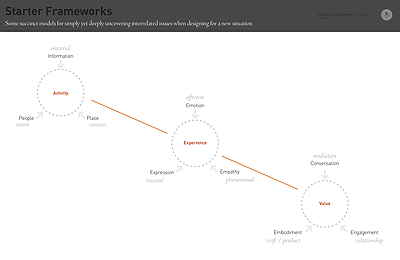
Yep, there’s contention about this, with lots of talk about “user experience” and how IxD is part of that. Sure, I play along too as a matter of pragmatics and lingua franca, for the past decade or so. It’s largely a business issue to relay to managers, HR, marketing, etc. I have no real practical issues, because I speak that way too with clients so I can get paid :-)
Philosophically, however…I’ll just point to this diagram for now.
Also on IxDA I described other issues I have with “user experience” as a term, and Jon Kolko followed up with an excellent articulation for why IxD needs to be addressed in its own right, not as “user experience”.
4. Interaction Design won’t have a well-defined skill-set until it has an educational establishment behind it.
I agree, but that has been established and is growing as schools like Carnegie Mellon, Stanford D-School, SCAD, RCA, Hong Kong Polytechnic, and others pursue the constant evolution and definition. Note that CMU’s IxD program has been around for a decade now, fairly well established. Jack Moffet has a nicely detailed account of the IxD skills needed.
In my view, these skills are different from “web design” skills and “industrial or graphic design” skills in terms of the artifacts created, but primarily in the mindset and perspective brought to bear upon the problem. Deeply contextual, situated, rhetorical, blending visual, logical, behavior/flow/architecture, with product strategy all at once. It’s not just creating icons or making logos or wireframes or flow diagrams, but all of them in concert in identifying the levels of problems: systemic, architectural, flow, screen, widget/component, data levels, all along the continuum. Mastery of leaf/tree viewpoints is essential just like for any designer, but especially so for IxD.
Also note, IxD skills are wonderfully supplemental and complementary to ID or GD skills, as a higher-order extension from paper and plastics towards pixels/time/behavior/flow kind of thinking–which is often invisibly apparent in other design traditions, just not as overtly expressed as it is in IxD.
I actually have a background in industrial design (Michigan, ’98) and believe that the best IxD’s come from either ID or Architecture backgrounds because they are already predisposed towards thinking about product complexity, contextuality, and functionality and variables of time, space, and motion.
5. Interaction Design is a religion.
Hmm? I’m not sure where or how “religion” as a concept fits into understanding IxD as an activity or profession. I’d be very careful about this. Could this not be applied to other design fields?
Perhaps what’s being implied is the strongly vehement nature of the debates on IxDA mailing list regarding boundaries, outcomes, titles, skills, etc. IxD’ers do hold very strong passionate opinions, which is simply the pluralistic nature of this emerging, still evolving profession of such expansive reach, from web to mobile to services to organizational design issues.
However, if this sentence suggests that there’s no common principles or “facts” and it’s all just personal belief, well that’s just not true. Jenifer Tidwell’s design patterns book, Mullet/Sano’s Designing Visual Interfaces, and Cooper’s About Face books all articulate clear fundamental, tested or otherwise empirically verified approaches, heuristics, guidelines, patterns, that serve as powerful references when confronting design problems…which is growing everyday as new situations are discovered and solved.
And for Carl’s final question: Do they constitute a new branch of design though? Emphatically the answer is YES. This is of course witnessed by the conferences, journals, job titles and salaries and HR assignment/organazational structures at almost every tech company, and more non-tech companies like P&G or Target are becoming enlightened about this. Perhaps even more though, is the potential for the field beyond just the immediate products and markets. From Dick Buchanan’s syllabus for his famous seminar on Interaction Design at CMU:
Interaction design emerged in contemporary consciousness around problems of the digital medium and the relationship between people and computers. However, interaction design has a greater significance than its application to digital products. It offers new ways of thinking about visual communication, physical artifacts, activities and services, and the systems and environments within which all products exist. For his reason, interaction design is more than a new branch of professional practice. It offers a new approach to design thinking in general. It provides the basis for a fundamental critique of the entire field of DESIGN and the place of design in human culture.
There’s so much more to interaction design, which is what gets me excited and passionate about it! Hopefully more will participate in the journey…