
Is interaction design a dead-end career?

Hmm! This arose via some comments by Bill Moggridge (esteemed “father of interaction design”, at IDEO, who coined the phrase) where he implied that interaction design may no longer be necessary as a discipline. It’s such a profoundly consequential thought that I’m honestly having difficulty getting my head around it!

Here are some discussion on some blogs, by Tim McCoy at Cooper and fellow CMU IxD graduate Jamin Hegeman.

There certainly needs to be some teasing apart of the concepts, like discipline vs. practice vs. profession, skills vs. craft, in particular.

But my initial response is this:

** Moggridge is so far outside the mainstream trenches of doing the typical work of software interaction design (flows, diagramming, wireframing, spec’ing designs, prototypes) for a company, as he’s such a broad visionary thought leader that his relationship to the discipline has kinda stretched and evolved so beyond “normal” designers…basically he as different view than someone like me who just started 8 years ago.

** What’s the proposed timeframe of this “dead-ending” of interaction design? (to use Tim McCoy’s phrase) Next year? 5-10 yrs? 20-35 yrs?

** What about all those fussy, frustrating, annoying “interactions” we’ve all had with badly designed websites, complex features, self-checkout at stores, movie ticket kiosks, mobile OS’s, in-car GPS units, microwave controls, home theater systems, online storefronts, etc. Someone armed with the skills/craft of IxD is clearly still needed for the foreseeable future! There’s SO much to fix, and to innovate further. Try printing a Word doc or installing an Adobe app or returning an item on Amazon. Thorny IxD problems!

** Ask Adobe, Microsoft, IBM, SAP, Oracle, Google, oh and Apple…do they think interaction design is fading away?! Hardly! The nature of software development cycles is such that IxD is and will continue to be needed (whether these companies properly apply IxD is a different question)

Ultimately, IMHO there’s still a TON of stuff to do that require interaction design (or UI/IA/UX/etc.) even if technologies evolve into a glorious symphony of haptic/neural/gestural/holographic Star Trek/Minority Report/Iron Man goodness of “natural interaction”. Someone will be needed to drive the humanizing of those technologies, the choreography of behaviors, mapping out the system of features, etc. The job title may not be “interaction design” but again someone with those abilities will be desired I think. Craft will still matter, skills will still matter, while the tools/tech may change. Time, motion, communication, expression, feedback, affordance, etc. all still matter in defining that relationship and behavior with users.

As long as there are technologies that shape human attitudes & behaviors & perceptions, there will be a need for someone to make them intuitively simple, emotionally appealing, and behaviorally impressive.

There is a distinct applicability of certain perspectives, methods, and principles inherent to the notion of “interaction design”, as written before on this blog repeatedly.
More on this soon…

In defense of sketching

I’m a strong advocate of sketching as a critical and fundamental design skill, as noted here. For me, sketching is not cool artwork, but a great rapidly visual way of processing information, working through problems, exploring lots and lots of ideas very quickly and fluidly. It’s not about “the perfect drawing” at all, which I think perplexes some IxD’ers (mainly those from HCI or CS, i think?) for some reason who refuse to sketch or think it’s not in their purview to do so. How can one design solutions without sketching (even if you’re designing systems/services/processes, etc.)?

Thankfully Jason Santa Maria iterates this point with his wonderfully concise and visually appropos posting here.

Why it’s “human”, and not “user”

I’ve personally had problems with the term “user” (as in user-centered design) for the subtle implication of a non-empathetic, sterilized, objectified view of emotionally, socially complex people, denying what makes us human. Of course, Dick Buchanan goes a few steps further, phrasing it brilliantly here:

What is important at the moment…the major tenet of new design thinking: the central place of human beings in our work. In the language of our field, we call this “human-centered design.”

Unfortunately, we often forget the full force and meaning of the phrase —and the first principle which it expresses. This happens, for example, when we reduce our considerations of human-centered design to matters of sheer usability and when we speak merely of “user-centered design. ” It is true that usability plays an important role in human centered design, but the principles that guide our work are not exhausted when we have finished our ergonomic, psychological, sociological and anthropological studies of what fits the human body and mind.

Human-centered design is fundamentally an affirmation of human dignity. It is an ongoing search for what can be done to support and strengthen the dignity of human beings as they act out their lives in varied social, economic, political, and cultural circumstances.

From Human Dignity and Human Rights: Thoughts on the Principles of Human-Centered Design, published in Design Issues: Volume 17, Number 3 Summer 2001.

A design typology continuum

This diagram wasn’t of much interest to ixda (who are more interested in password security settings or delete buttons, rather than critical design theory) but perhaps this is of interest to you, GhostPixel reader ;-) Here’s an attempt to make sense of the recent (and ongoing) Cambrian-like explosion of new design activities, fields, or domains of practice that has caused some angst and confusion among those who affiliate themselves with “interaction design”.

A Design Typology Continuum: http://bit.ly/vYbBl

This poster is a personal attempt at making sense of the craziness of the design world lately, heavily based upon Richard Buchanan’s “Four Orders of Design”, which succinctly maps out the development of design moving from “posters and toasters” into the new challenges of social interaction, information architecture, service design, and managing as designing, in the business arena and beyond, into general culture. I’m not sure of Buchanan’s latest thinking (his model is at over 10+ yrs old now) but I’ve updated the language to reflect much of thinking going on around “design thinking” and “transformation” and “digital product design”, for example.

Some things to observe in this diagram that warrant further pondering:

# The movement (Left to Right) from concrete, materially crafted results (“things” ) towards increasingly abstract, immaterial outcomes (“activities” ) that elude easy pointing and saying “this is the result”
# Relatedly, increasing degree of complexity and “wickedness” of problems, entering realms of business, society, and culture
# The materials of design evolve from tangible (inks, matter, pixels(?)) towards intangible (values, attitudes, lifestyles), further fuzzying conventional design boundaries and provoking “what is it designers do?” sorts of questions
# I deliberately made the visually richest area to be in that middle zone between 3rd and 4th Order, as the place we’re at now, with so much potential and excitement and lots of happenings going on now in Design at-large. I sense there’s some cycling going on, with methods and approaches across the Orders feeding and impacting each other.
# I think these need to be highlighted in some way: Digital Product Design (for lack of better phrase) and Social Change, so I created sub-clusters, positioning them near the 3rd / 4th Orders. These seem to be the “hot” areas now deserving attention, from Web 2.0/SaaS/multitouch to designing for eco/green, or Third World, etc.
# The final part at the far right, hypothesizes what may be next, “massive change” (borrowing Bruce Mau’s phrase) featuring truly wicked problems…perhaps the ultimate field of design is focused on ethics, involving transcendental & universal values of culture/humanity/society to tackle huge problems impacting govt, edu, poverty, human rights, etc. I don’t know, but I sense that may be on the distant horizon (or how the trajectory is aiming)

Of course this will be constantly evolved and iterated upon…

Further discussion on ixda where I originally posted and have some comments/replies, here.

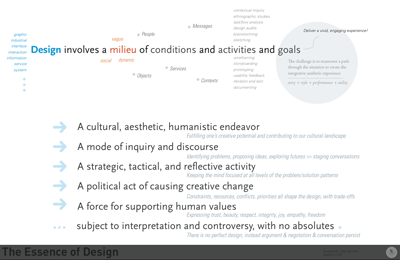
The essences of Design

I created this a little while back, as a short poster to distribute online. Yet another personal attempt to articulate succinctly the wide range of definitions and purposes of Design as a compact yet visually tasteful statement.

Some of the key points:

** Design is a cultural, aesthetic, humanistic endeavor
** It’s a mode of inquiry and discourse
** It’s a strategic, tactical, and conceptual activity
** Politics is at the heart of design, creating change
** And it’s a powerful force for humanity

And of course all of this is subject to ongoing interpretation and evolving perspectives :-) But I believe it’s a good start…

design_def.png

Click the image to download the PDF