The most important customer = the employees!

Without a well-trained, highly motivated, confident employee workforce it becomes very difficult to create and deliver rewarding products or services to customers. Those same employees are the ones who should be fielding inputs from both happy and unhappy customers to help guide successful outcomes for everyone in the ecosystem. If you care about your external customers (who pay money for your product or service) then you must care about your internal customers… the very employees that you pay (salary or whatever) to get stuff out the door! (and reinforce your brand promise as a symbolic delivery vehicle) Indeed, the “company” at the highest levels (meaning the executive leadership and senior-most staff, in the core domains of the company) must treat their employees as their most important customers, identifying their needs, reinforcing the value prop delivery, and ensuring successful outcomes. It’s more than simply keeping that particular kind of customers happy…it’s just as you would do for an external customer– amplify the brand, get the employees passionate for the company’s cause, enable their career path success, create opportunities for significant feedback and iteration, reward exemplary efforts, etc. 

 
For when an organization realizes that the employees are its first and foremost customers, then real customer experience magic happens. It takes a village, true…but it also takes a committed, valued, empowered team that feels respected and part of something larger to deliver to external customers. 

The future of IxD via New Yorker cartoons

I, as many people do, love the culturally savvy wit of The New Yorker cartoons. My adoration rose another level when I came across these two exceptionally relevant cartoons from recent issues, which humorously foretell certain challenges for interaction designers in the coming decade and beyond. 


Newyorker touchscreen

 
The first image speaks to the popular notion of younger generations (i.e., children) developing new mental models in their still-forming, impressionable minds and applying that everywhere, even where it’s somewhat absurd. But is it? I can’t help but recall Corning’s “Day Made of Glass” videos when I saw this cute image, and the implications that perhaps, a “basic” glass window could actually become amplified to serve as a touchscreen and more: What if I could pinch and zoom on a window glass to magnify what’s outside my window? Indeed the mad hatter of a heiress Sarah Winchester herself at her infamous mansion physically  installed windows with circular elements that were actually magnifying lenses so she could take a closer look  at guests approaching the property (she was a bit paranoid). What if the window were electrostatically & digitally charged up to respond to my touch and present contextual info, the equivalent of Google Glass with augmented layers of reality about the view outside: the weather, grass condensation level, UV levels, how far away is the UPS truck, where is the school bus this moment, etc. That child in the cartoon may be quite ahead of our times, with a host of interaction potential awaiting her.


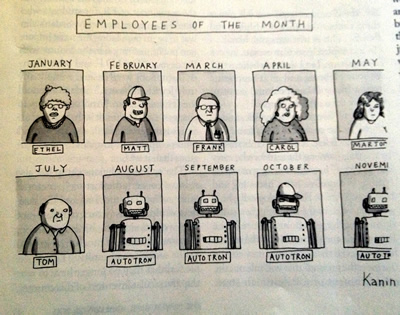
Newyorker robots

 
The second image also speaks to a common notion of robots taking over the workplace. Ever since the Jetsons with their robot maid Rosie, the popular idea that robots would someday do our most tedious, laborious work has become almost cliche. But now, from major manufacturing and electronics firms employing robots on assembly lines to having Roombas do our carpets at home, it’s not that far-fetched! And it does raise questions about a robot-driven labor force: labor rights, appropriate pay/costs, maintenance & upgrades, recycling and reconstitution of robots, equitable workplace with humans and robots, etc. A host of social and interaction issues pertaining to the co-location of artificial yet participatory entities that interaction designers will need to be mindful of. Will it be a future of robot vs human competition in the market, or one of peaceful cooperation and co-existence at myriad levels of social acceptance? This cartoon may paint the way at looking a bold robotic future.

Watching some technologies & trends

I finally surveyed a large set of links and articles collected over the past several weeks, towards the end of 2012 / start of 2013, about emerging trends and technologies UI designers should be aware of. Below is my brief assessment of what jumped out as compelling, worthy of watching in the coming months…Enjoy!

————————-

** Visualizing “Big Data”: The convergence of velocity and variety of massive amounts of unstructured data, with popular desire for beautifully represented, easily digestible illustrations will lead to increased demand for data visualization experts–both technologists and designers. Computational data artists from MIT Media Lab of the 1990’s make a comeback?? It’s notable that Lisa Strausfeld, who help pioneer computationally driven info viz at MIT, is a “Senior Scientist” for the Gallup Organization. Hmm!

** Related to this is personal data analytics: from bodyware (Fitbits, Nike Fuel, Jawbone Up) to the social graph (Facebook, Twitter) to location data (Google Maps, Foursquare) to…who knows what else? What are the tools and visualizations to discover, analyze, synthesize, generate insights and opportunities, etc. Big opportunities that seem to keep increasing with more market demand.

** Mobility evolves to the next level of pervasiveness, further shaping BYOD policies and attitudes. “Any-ness” is now becoming accepted in corporate contexts as a de facto expectation by the workforce, requiring secure app/data/device management abilities that’s not a burden on users. Balancing convenience with control will be paramount! It will take nuanced, strategic design thinking to support that challenge.

** The multiscreen world is here. We’re now living in an “Age of Multiplicity”, with at least 3 or 4 screens (phone, tablet, laptop/desktop, and HDTV…not to mention the car dashboard/Navi too!). Taking advantage of multiscreen interaction patterns will be valuable to enhance and not just merely replicate everywhere the software experience for a screen. Need to think about how the screens can cooperate and shape an amplified interaction-communication experience, via simultaneity, coherence, complementarity.

** 3D printing is red hot! Everyone is buzzing about it and with costs coming down, it will begin to introduce a bold new wave of micro-fabrication capabilities…and policies, regulations, services, even ethical dilemmas: What if you can manufacture a gun (or worse) in your own home?? Uh oh. Big issues!

** An emerging “Internet of things”: Sensors are increasingly everywhere, with the ability to message remotely from inanimate objects, trigger actions based upon conditions (all programmed simply by using a website or mobile app). Truly things are now talking to us, and the Internet is becoming embedded in ordinary objects. Large industrial giants are looking deeply into this!

** Robotics. Always a notable area, but beyond just the consumer-friendly Roomba, we’re starting to see rise of new kinds of robots which are almost appliance-like and a personable fit for human interaction in the office or hospital. Is a Jetsons’ style maid far behind?? The interaction and user experience dimensions will be paramount. Also: robots are not just anthropometric in appearance, but could be your car.

The value of visual design

To an uninformed or stubborn engineer and product manager, “visual design” (that is to say, the graphic design of an interface with pixel-level precision and accuracy) is merely icing on the cake, fluffy and fun, for adding a certain “sparkle”. It’s not the deep, heavy, rigorous functionality that justifies the product’s existence, thus summoning the investments, valuations, and customer fees. 

The fact is, however, the clearly refined nature of a product’s visuals impacts several things that effect a product’s usefulness and thus the business’s financial value:

 
1. First impressions matter: Would you pay big sums for something that looks like a child finger painted? Of course not… Thanks to the iPhone and many strongly visual product experiences like Flipboard, Tumblr, Pinterest, Instagram, we are undoubtedly in a visual culture. People really do notice when something looks poorly crafted, signaling distrust, skepticism, and doubt. That first impression sets the tone of who you are and what you represent in the mind of the user and market. You rarely get a second chance to improve that first impression, just like in social situations in real life. 
 
2. Visual design is about communication: Forget the “prettiness” aspect for a moment. All those critical elements of the graphic design (hierarchy, balance, emphasis, contrast, whitespace, etc.) are choreographed not just to make something merely attractive, but also to convey the purpose of the product, the utility of the interface, including the content and functionality. If a button or drop down menu is lost in a sea of clutter, or obscured by overdone styling, users won’t get it.
 
3. Supporting eficiency and productivity: To help the product’s users get their jobs done swiftly with confidence and satisfaction, visual design is absolutely essential to that effect. Aligning elements properly so user can quickly scan, exposing the button clearly with strong labels so user can take correct action, cleanly exposed menu/navigation so user knows how to get back to where they were, or move around your product easily…All of this impacts productivity. The more clutter, chaos, confusion in the UI due to lack of properly applied visual principles (not to mention poor content strategy, another topic!), actually hurts user efficiency and productivity. The user is wasting precious seconds or minutes hunting around or doing trial-and-error to achieve a desired outcome. 
 
Let’s not ignore or belittle the value of visual design in designing amazing digital products. It could quite literally be to the business’s demise if left unattended or treated as an afterthought. 

Evolving the brand

As I embark upon 2013 replenished with post-holiday optimism and energy (not to mention a slightly bigger tummy!), I’m keenly aware of my own burden in evolving my professional development to the next level. Elevating my profile of being a “principal designer” for a major enterprise software firm towards a industry-level thought leader shaping discourse and guiding critical insights for future designs. In a word, it’s about being a sought-after “brand”…how am I defining and shepherding my brand, my own distinctive philosophy and repertoire of design experiences, for productive gains for myself and my constituents?

This got me thinking that a brand, whether of yourself or of a product/service (like Nike or Zappos), involves three core interrelated aspects:

* Presence: Do you (or the product/service) have authentic visibility in the minds of your target audience? (i.e., mindshare) Are people aware of you, recognize you, comprehend what you do and stand for? Do you, in a sense, register in one’s consciousness, worthy of recall and reference later? And at what scope and magnitude? Just your initial manager, or even further, including the CEO and other Exec staff members? What about partners and customers? etc. etc.

* Impact: Do you (or the product/service) have some specific targeted impact, or outcome that’s tangible and demonstrable (preferably repeatable) that people can point to? What’s that impact upon someone’s life, whether in work or in life? Basically, have you done something of merit? What have you delivered and achieved that’s real? 

* Value: Do you (or the product/service) have some quality of lasting value, that’s of deep relevance and significance, and of measurable benefit, whether in dollars or in emotive gains? Will people miss you/your offering and see diminishing returns after your departure? How can that be captured and transferred back into a productive loop with your target audience and related stakeholders? How do you enable a mission and purpose of your company or industry or market?

Perhaps as you think about your own professional brand (and that of your product/service offering), you may consider these integral aspects of presence, impact, and value. Their interrelationship leads to a powerful binding force that authenticates and substantiates the brand as something lasting, not just fleeting.Â