Data and intuition: A peaceful coexistence?

As digital product designers, we’re thrown into complex, tense situations trying to make sense of it, including the audience, context of use, and core functionality. Via user-oriented methods we’re taught to not rely upon initial instincts but instead well-grounded “data”, to ward off the rapid fire attacks of suspicious engineers and skeptical executives anxious about their dollars’ applied toward something to guarantee a tangible ROI. Indeed, we must venture into this contest wearing a flak jacket of “data” to protect ourselves from random volleys of anxious emotions. But what does that mean, to have data?

The commonplace notion is “data” encompasses all those usability-lab tested numerical stats or click traffic or rigorous scientific formulae. Actually, there are other kinds of metrics—qualitative and quantitative—such as market share, audience growth, customer satisfaction, and NPS scores. Plus, with ethnography, affective research, and story-based methods, it’s clear that the boundaries of what constitutes data are broadening.

Indeed, just as valuable, is the data of one’s experience: the empirical, observational, and anecdotal types arising from watching and listening to people in their actual context, which adds richness in terms of the nuances of goals and subtleties of problems, beyond what web analytics can provide. Debra Dunn, of Stanford’s d.school (Hasso Platner Institute of Design), says that adhering to Web analytics “makes it very difficult to take bold leaps; it is more from engaging with users, watching what they do, understanding their pain points, that you get big leaps in design”.

Another type of data that shapes design decisions is the designer’s own evolved sense of judgment, perception, and informed intuition, after several years of working with clients/projects across diverse contexts. (Before you scoff, isn’t this true for veteran surgeons, lawyers, accountants, executives? Why not for designers?) For such seasoned, mature designers, this is a vital kind of data from actual field experience in leveraging past mistakes, lessons learned, patterns identified, and drawing upon that reservoir accordingly. The world’s best surgeons are no different in their practice and use of “self-reflective” experiential data to yield superb results. Instinct (in this sense) is simply refined, natural judgment.

Digging deeper, we see that underlying this bias toward “hard” quantifiable lab-based data is an assumption of proving isolated pieces of design solutions as truth, absolute and final.

This contrasts sharply with approaching design as a holistic demonstration of an idea for iteration and evolution in cyclical fashion, towards rapid learning. There needs to be greater appreciation of the fact that data is not truth, but is merely one point in the deliberation over what is appropriate for a context, shaped by healthy skepticism. A productive approach requires a liberal interpretation of data, acknowledging multiple flavors as valid and legitimate, for different phases of a project, given the various constraints and demands.

Ah, there’s the rub—interpretation. All data is subject to human interpretation, and humans, as we all know, are imperfect! As Jared Spool famously said at Interaction’09 conference awhile back, “Any piece of data can be whipped to confess to anything”. In the end, data is used either to support or repel one’s argument. Indeed, design is an intensely deliberative human activity, grounded in debate–even manipulation—toward some reconciling of viewpoints into an outcome. That’s the real battlefield of ideas contested in action among business, engineering, and user experience. Data helps enable and shape a conversation towards shared optimal resolution, not conclusively finalize it. It’s the peaceful coexistence with professional judgment and experience that makes such decision-making more effective and perhaps even right.


Some tips on leading designers

I don’t manage a team of direct reports. Yet as a Principal Designer on a strategic in-house design team, I do serve in a valued leadership capacity of influence, role modeling behaviors and approaches, for peers and junior staff alike. Having worked over 10+ years in Silicon Valley, I have observed what works (and more importantly, what doesn’t) amid a range of contexts, including startups, studios, global innovation agency, and major software companies. I have continuously tried to reflect such observations on how I perform as a design leader. It’s not easy, but definitely an eye-opening journey ;-)

So, below is my summary on how to guide the creative, innovative power of designers within an organization, leading them towards inspired excellence, not just managing the minutia of process adherence.

** Trust and respect are paramount: These concepts form the basic fabric of an elastic working relationship of partnership, that can weather many a storm of disagreement and disappointment, which will be inevitable when guiding the creation of something profoundly novel, and even scary, to others. They also serve as the bedrock of positive collaboration, where ideas can scaffold towards what is desired and needed. Without trust and respect, your designers will disappear and any hope of a design culture will be utterly lost…possibly forever.

** Transparently engage collaboration: No black boxes! See-through glass walls & open doors are the key to success, where everyone feels like a real contributor and partner in the design process. I realize Apple and some others don’t function this way. I’m mainly speaking about corporate settings where “design” is a very novel, perhaps feared or distrusted species in the company ecosystems, to alleviate any suspicion or doubt. Everyone must feel welcome and respected, to smoothly collaborate. (Related: don’t mandate collaboration as a “police action”…It has to be a cultivated desire that is sought after. Non-designers in particularly should feel “enrolled” into the dialogue, joining it, not coerced.)

** Challenge designers with relevant, meaningful problems: Designers of nearly all stripes and patterns and temperaments crave juicy, hearty, interesting problems of real impact–from conceptual next-gen studies to fixing the anachronistic “save” icon for today’s Millenials. Designers want to prove themselves and take their skills/experience to the next level through new domains, user types, tools, and styles, not just serving as a “service group” chopping up icons for tomorrow’s PPT review. This is part of respecting designers for their value, inspiring them to tackle what’s real.

** Replenish and reward, generously: Design is hard work. Really fracking hard, for all the various reasons of politics, team dynamics, tech constraints, market whimsies, etc. You need to recognize the tremendous effort put forth, with public acclaim and valuable rewards, from a cool t-shirt to movie outing to pay raises. (or all of above!) Some may like a simple gesture, others may need more (I’m still waiting for my boss to give me a Porsche ;-) But this is clear: Nobody likes to be taken for granted, especially those who struggle to invent solutions yearning to burst forth from their minds and hands, facing critical skepticism every step of the way until users smile in delight.

Also a big part of this is factoring “reflection time” for designers to stand back, absorb, and process, not mechanically forcing “death marches” to get a design spat out. This helps replenish the mind, eyes, and hands– the essential elements in coherently creating the best solution. A burned out designer with Photoshop (or wielding a Sharpie) is not a happy situation, trust me!

** Support learning and cross-pollination: Most designers by their very nature are naturally curious and want to know how something works, how to make their designs better, how to gain stronger skills and advanced tools. There’s something special I think about the design community and their consummate obsession for conferences ;-) From the social exchange of unique ideas, to the inspirational fodder of bold visions, to the enrichment of practical skills via workshops…it all helps foster a learning culture and progressive mindset necessary for a thriving design culture. Relatedly is cross-pollination, something that’s again inherent to how most designers operate, to help target the best ideas for a problem.

** Create a space that inspires & enables: Designers need both physical and cognitive spaces to explore ideas, shape out concepts, collaboratively AND individually, as needed. It’s a balance of work styles and personalities that evolves in the course of a design project. Movable furniture, lively imagery, natural light, writeable surfaces, tackable walls, fodder for inspiration (magazines, games, movies, posters, etc.), and even radical departures from the norm like a “secret room” with atmospheric mood…all of that can help spark novel thinking. Also needed are structured spaces for serious discussion with non-design stakeholders. It’s not an “either/or” but a “yes, and” flavor of thinking when it comes to space design to enable design success to repeatedly happen.

And one more thing… Don’t ever call designers the “creatives”. Creative is an adjective, not a noun. You’ve hired professionals who are designing the future of your company, delivering products, services, and experiences that will engage with your upcoming markets. They are PARTNERS in delivering excellence, not some “wacky creative” who snickers every time they hear “420” (although that’s often true too, sigh). Check the useless stereotypes at the door, and embrace the collective wisdom of multiple, conflicting, empowering perspectives about what’s useful, desirable, and valuable towards making the best decisions for the team, company, and customer. Because at the end of the day, the company exists for one reason: to create and deliver value to customers. Designers rightfully have a place in that collaborative endeavor, so make the most of it!

On designing with execs

Executives are kind of a funny lot. Not all are trained to be group collaborators yet coordinate with very strong personalities. Most are driven by fact-based proven statistical metrics yet want that elusive charm/desire factor for buzz and sales. Many speak of brand values of the company yet make agonizingly tough decisions that seem counter-intuitive, impacting the team or product. Whew! How in the world do you design with or for these folks? It can be a trying experience for the unprepared, no question!

Yet having the memorable opportunity to engage with executives to debate concepts and shape customer experience strategy…well that’s simply priceless! You want to make a great impression at the table, so to speak.

Below are a few lessons I’ve been quietly capturing lately, per recent experiences on various projects with execs:

Assert your point of view. You’re there for a reason, take advantage! Make your informed opinion known. That might mean talking over them and “elbowing” your way in a bit (many have strong points of view themselves to assert!) but they will respect your direct, candid perspective. (Corollary: Don’t apologize, ever, for anything. Simply assert and focus, very briefly. Execs are time-pressed!)

Simplify and explain the concept like to a child (not that execs are child-like, of course ;-) Use visuals! Avoid the temptation for geeky “design-speak”. Use various familiar analogies and metaphors, particularly from pop culture or everyday objects & tools. 

It’s ok to disagree, with defensible credible rationale. Beware: “because It’s cool” is not a useful rationale (unless speaking strictly of style trends)! There will be merciless disagreement if you say that. Be objective and reasoned.

Don’t attempt to wear hats you’re not qualified to wear, like marketing or engineering. If you don’t know, admit it and request proper inputs from those peers.

Many execs love to sketch and visualize their ideas! Let them and then leverage that for productive discussions. Poke holes and raise critical issues (respectfully ;-)

– They want specific, tangible, immediate ideas and actions, not abstractions or theory. Keep that at home. But explain the principles behind your suggestions, framed by concrete examples with real data as much as possible.

Going beyond just “validation”

It’s typical among Lean Startup adherents to speak of “validation” and “customer development”, as part of the rapid iterative build-test-learn cycle inherent to the Lean philosophy. Formed an assumption about the customer? Validate it. Got a new hypothesis about the problem? Validate it. Exploring some delivery tactics via a fake website? Validate it.

Validation is the heart and soul of Lean, pushing the product team brimming with self-created enthusiasm “out of the building” to speak with actual people to gather their feedback, reduce risk, and ensure success before moving on to the next decision point.

However…there’s a small problem with the word “validation“.

Looking closely, it implies an exactitude of guaranteed correctness, that you’ve got the right answer, so you can successfully move forward. You can almost hear the stamp going “thunk” on the paper, with the certification of proper results, as the team smiles, knowing that they “got it”. This attitude presupposes a correct definitive answer, can constrain the ability to see fringe ideas, and inhibits openness to new possibilities unforeseen during testing. 

As anyone knows who has gone through not just design, but also the fuzzy front-end of product innovation, there are no predictable guaranteed outcomes, due to the dazzling array of uncertain variables and risk factors beyond your control.

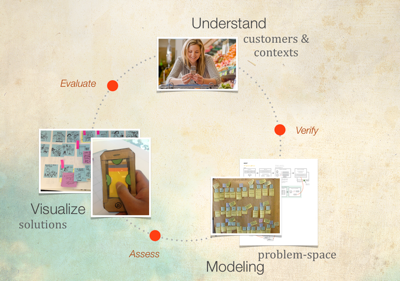
Besides, all data (quant or qual) must be taken with grains of salt due to the contexts of the feedback sessions. Therefore, instead of singular “validation”, it’s preferable to break down this nearly ubiquitous phrase into the following concepts, that map to primary phases of a user-centered design process, as shown below:

3partcycle

After understanding targeted customers and contexts, then Verify your personas and scenarios with actual users and other stakeholders to ensure accuracy of perceptions. (Like the old adage, “trust but verify”)

After creating diagrams and taskflows/wireframes, then Assess your models of data interaction and information architecture with Product Managers and Engineering leads for completeness of capturing and representing all the relevant tasks and objects and functions, and such. This can also be assessed with targeted users with proper framing of the activity and what’s to be shown.

After producing some solutions, then Evaluate such visualizations and/or prototypes (of varying degrees of fidelity) with targeted users through properly framed feedback sessions to catch usability problems, missed features, and other forms of improvements. 

These terms point to a more nuanced sense of “validating” what’s appropriate for your targeted market and context, as an ongoing process of learning and understanding and thus, innovating. It’s going beyond simply a convenient stamp of approval (“validation”) but creating a dialogue of realization. Inventing solutions is a journey of seeking, not a singular moment of final absolution. It takes several rounds to get it moving on the “right track” towards satisfying users ;-) 

Quick reflection: Design as a confidence game

I don’t mean a “con game” whereby someone is getting swindled out of a proper deal and left holding the bag. I mean, there’s a game of coordination and competition amongst stakeholders (Biz, Tech, Marketing, etc.) with diverse (or perhaps at-odds) interests, priorities, goals, agendas that must be somehow mutually enabled into some harmony of purpose and value. For the designer, this often requires tough, smart, negotiated compromise while striving towards an ideal vision of what’s best for the users and the business. And this means, as the designer driving the (user-oriented) end of the deal, you must be confident in your approaches, speak with a voice of conviction (“Have a point of view”, as Citrix CEO Mark Templeton likes to say), and design capably with a sense of ambition to carry the team and company forward, not simply settling for “low-hanging fruit” or “table stakes”. Marshaling a vision that encompasses the widest range of criteria yet addresses the sharpest, focused needs of a distinct persona can be incredibly difficult, and it takes a strong dose of being confident to instill confidence in the team members striving to achieve what seem impossible. However, you must also have the humility and self-awareness to step back and realize when not to overstep your place on the field of play. Sometimes certain levels of accomplishment take more time and slower progress than expected, with small battles cast aside in service of better collaborations.