
What’s wrong with UCD?

Nothing, as long as you approach UCD (User-Centered Design) as an over-arching philosophy and general framework for considering people in the design of a product, in addition to all the other concerns. Held lightly in the mind as a “mode of thought”, UCD can be very useful in helping those who are engineering-centric or accounting-driven to broaden their perspectives and take into account other priorities and values as well as the mainstay of features and profits. In other words, the priorities of people, the actual users of the product, become a primary focus with the other critical issues. Of course, there is no one “end all, be all” UCD definition, or method, or diagram, or pledge of allegiance, or anything like that. It’s all exceptionally diverse with multiple flavors used by different companies/designers, but  bound by an overall premise: people matter.

In my view, UCD is really just about taking the product’s users into account, balanced with business and technical concerns, along the lines of the rhetorical balance. Interpreted through the lens of shaping an effective argument, UCD activity should really be a deliberative process of discovering the right balance of trade-offs, constraints, priorities, and values when collaborating with product managers, engineers, marketers, and other participants in a highly complex product development process.It’s not about the primacy of one “UCD method” versus another “UCD method”, or the centrality of a specific user research deliverable over all else (much of which should be taken with many grains of salt anyway) and taken as “starter fodder” to have something to work with.
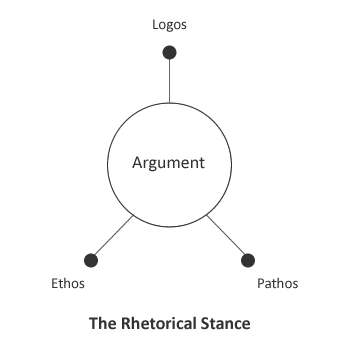
However, there is great discussion in various circles about the semantics of the term, with focus on the actual literal meaning of the specific words (e.g., user centered design) as being exclusive of business and technical concerns. It’s a fair point to argue as many do on ixda for instance…perhaps creating more confusion along the way :-) As purely a label, it just seems to me that UCD has become a de facto, commonplace, accepted phrasing used in conversations with business and technology leaders. The phrase has gained traction across the high-tech industry, design academics, new design graduates, and so forth. There’s a general gist of what’s meant by it that most people grasp well enough. That’s mainly why I have accepted the label and simply moved on; besides, I’m too busy designing to worry about what to call the damn thing :-) The bottom line is that designing something involves multiple centers regardless; the trick is how to balance them altogether…

What we need to be clear on is what UCD is NOT:

  • UCD is not simply “giving what the user wants”; designers are NOT short-order cooks and most folks have no idea what they truly want (beyond vague phrases like “make it simpler, easier, intuitive, get rid of all the buttons, bigger icons, etc.”), or have difficulty expressing their desires accurately
  • UCD is not a commodotized recipe for an “easy to use” design; just like any design activity, there’s iteration, fast-failure, re-visiting issues, and yes mistakes do happen!
  • UCD activity and decision-making should not be ignorant of other concerns (business, technical, etc.)
  • UCD is not a panacea that will fix all problems; product design problems are often way more complicated than simply “what’s best for the user”, often requiring inputs and trade-offs with various departments, teams, professionals, etc.
  • UCD is not an exclusive, guaranteed approach. It is one approach to design that is best taken with several grains of salt, and perhaps better when mixed with other approaches (Activity-oriented, “Genius”-oriented, etc.)…The master designers know how to tactfully blend, which comes with years of experience of course.

What’s still perplexing for many folks is how to account for supposedly “non-UCD” successes like the iPod, iPhone, Dyson, Michael Graves collection at Target, etc. (Although you can argue that people were considered at the forefront of the designers’/engineers’ minds, just not in a regimented, exclusively method-centric fashion). Perhaps what’s needed is a better understanding of UCD thought & practice framed as just one part of a much greater (and complex) product development effort, as I suggested above… More on this soon.

Quote of the day

From Vlad Margulis, UI Designer at Google:

Just as speed doesn’t define the essence of a jaguar, but merely represents a trait that evolved for its survival, intellect doesn’t define the essence of a human being. The essence of humans is the depth and range of emotions with which we experience our interactions with the world.

What is design?

From various notable personalities in the design world, collected altogether…

“In essence, design offers a pathway for bringing theory–ideas bout the nature of the world and how we should live our lives–into closer relationship with practical action and the creation of diverse kinds of products and experiences.”

— R. Buchanan, Design and the New Rhetoric

“Design is the art of causing change to occur in accordance with taste and intent”

— Clement Mok, Time for a Change

“Design is the method of putting form and content together. Design, just as art, has multiple definitions; there is no single definition. Design can be art. Design can be aesthetics. Design is so simple, that’s why it is so complicated.”

— Paul Rand

“Design is a plan for arranging elements in such a way as best to accomplish a particular purpose”

— Charles Eames

“Design is the fundamental soul of a human-made creation that ends up expressing itself in successive outer layers of the product or service.”

— Steve Jobs

“To design is much more than simply to assemble, to order, or even to edit; it is to add value and meaning, to illuminate, to simplify, to clarify, to modify, to dignify, to dramatize, to persuade, and perhaps even to amuse.”

— Paul Rand

Not as faddish as people think…

Sure, design “coolness” tends to evolve in waves in pop culture and media portrayals (Time, Businessweek, Fast Company, etc.), but most people don’t realize the following faddish and over-buzzwordy terms are actually quite old, several centuries even!

1. Innovation: Rhetoric as originally described by Aristotle, and later evolved through Cicero, was fundamentally about the art of innovation using the material of words and language to persuasively communicate among fellow people, creating powerful arguments in an inventive manner

2. Experience: Long before Nasdaq companies co-opted this buzzword into their marketing and branding, a pragmatist philosopher named John Dewey in early-20th century America rigorously studied (and hypothesized upon) the connections between education and human experience, and how to create an optimal experience of form/material/emotion towards improving someone’s daily life, which he termed “an experience” (as opposed to an “inchoate experience” full of distraction, disconnection, and thus dissatisfying. Plus, his contemporaries were Moholy-Nagy (Bauhaus) and Paul Rand (Yale), both of whom read and were inspired by Dewey’s seminal text, “Art as Experience” (this is required reading at CMU and IIT). Dewey was basically an experience design strategist in 1935!

3. Design: It seems the dot-com craze propelled design into the public consciousness (along with Apple, Ikea, Target, Nike) and thus it has taken on so many varieties of flavors, losing its meaning, blurring distinctions. But in the 1950’s Nobel Laureate (economics) and cognitive psychology expert Herbert Simon (formerly of CMU) advocated a very broad definition of design in his major text, “The Sciences of the Artificial”, in which he characterized a designer as “anyone who devises courses of action aimed at changing existing situations into a preferred situation”. For him, the study of humanity is the study of design (decision-making, problem-solving, etc.) Unfortunately his ideas got jumbled up by HCI and AI people…resulting in CHI :-) (ok, i’m simplifying a little bit…)

So while innovation, experience, and design may seem like “the new black”, they’re actually familiar and respected concepts.

The machinery of desire

Tuesday morning Steve Jobs delivered his annual Macworld keynote address to adoring Apple fans at SF’s Moscone Center (and those following along via live blogs), introducing the intensely rumored super-thin laptop computer, dubbed the MacBook Air (or “airbook”, as I like to informally label it).

From a product design POV, it is quite simply a marvel of innovative engineering that embodies the now-familiar qualities of the modern techno-consumerist aesthetic: sleek, sexy, shiny, radiating simplicity and sheer elegance (or the perception of such) and serving as a spotlight of “hope” for something new (i.e., digital) and progressive. In a word (or two), fetishized technology, catering to a gleefully unhealthy addiction to the novel (see Crave, Gizmodo, Engadget, and Geek Sugar). A materialistic revelry, if you will.

This latest product is a fitting descendant of what started with Steve Jobs’ second arrival, beginning with the original iMac, then continuing with the iPod, the revised iMac, the iPhone, and so on. Each of these introductions generated extraordinary buzz across industries and social circles, influencing the design languages of competitors, followers and wannabes, not to mention the other pieces of the ecosystem, like web designers and TV advertisers. Tired of Web 2.0 over-trendiness? According to one designer, it all started with Apple, the “undisputed shiny kings of sheen”!

Apple has used this look with subtlety and its portrayal is always in a constant state of evolution.

Ultimately, Apple is flat out brilliant at cultivating and sustaining what has become in effect, a kind of “machinery of desire” that we follow and participate in as voyeurs, as consumers, as hapless fans shelling out the cash (or credit card). It’s a social, cultural, psychological, and deeply emotional effect, playing to our search for something new and fresh and innovative…something different! And of course, Steve Jobs, being the maestro performer he is, plays to that beautifully and knowingly. He’s a superb rhetorician, masterfully balancing the rhetorical stance, although you could argue he over-states the ethos and pathos aspects, tipping the balance in favor of pulling people’s heartstrings with over-dramatized effects. (Pulling out the super-thin laptop from a manilla folder on-stage was just brilliant!)

As a side note, what’s he really thinking in this photo, portraying a Messianic savior presenting the ultimate divine revelation for public consumption. Perhaps he views himself as a modern day Prometheus, bringing fire down from the gods. “Behold! I offer life eternal!” (As we all silently curse pulling out our credit cards, “that bastard…damn you!” yet we all secretly enjoy it :-)

But regardless of the egotistical issues, I think if you take a deeper look, these “steve-notes” are not about the product, or the technology, or their supposedly user-centered qualities. No, these annual performances (and the company and products overall) are much more about the creation and sustenance of desire, the raw human emotion itself– transforming it into a cultural phenomenon and engine for profits, business, innovation, and yes, design appreciation. Apple creates and sells desire. Plain and simple. And in doing so, Apple is vital to the  design discourse, for designing is fundamentally about shaping people’s emotions, values, and lives…and experiences.