
Good description of empathy

One of the cornerstone qualities of a good designer, is empathy. Daniel Pink, author of “A Whole New Mind” describes it like this:

Empathy is the ability to imagine yourself in someone else’s position and to intuit what that person is feeling. It is the ability to stand in others’ shoes, to see with their eyes, and to feel with their hearts. It is something we do pretty much spontaneously, an act of instinct rather than the product of deliberation. But empathy is not sympathy–that is, feeling bad for someone else. It is feeling with someone else, sensing what it would like to be that person. Empathy is a stunning act of imaginative derring-do, the ultimate virtual reality–climbing into another’s mind to experience the world from that person’s perspective.

One point I’d tweak is about deliberation. I’d say that as a designer, undergoing rigorous persona and scenario development via observational studies and participatory activities, those are deliberative methods at forging empathic connections, and shaping that “imaginative” aspect of feeling, sensing, and knowing…
Good book: The Adventures of Johnny Bunko (seriously!)

I think it’s a fairly common storytelling refrain among popular career and business advice books to portray a hapless white collar “knowledge worker” glumly pining for a more fulfilling job, complete with perplexing axioms that read like Zen koans echoing the spirits of Deepak Chopra & Peter Drucker. But how many of them present that in the form of a manga comic book?? (complete with Japanese phrases and fantasy spirits??) That’s what grabbed my attention while perusing Kepler’s Books yesterday, when I discovered Daniel Pink’s Adventures of Johnny Bunko. The format of a manga made the usual “self-help” book memorable, engaging, humorous, and altogether inspiring. Just like the Scott McCloud Chrome comic-style introduction by Google (exhaustively) explaining their new browser, Pink’s book creatively relays typically dry prose info into a more inviting format, which as a designer I greatly appreciate!

Key takeaways

— Approach your career with “Enlightened pragmatism”: judiciously making choices per rational evaluation yet with emotional idealism, taking advantage of serendipitous moments as they arise

— Base a career/job choice upon “fundamental reasons” (inherent value of enjoyment and self-enrichment) rather than “instrumental reasons” (temporary stepping stone to something else, extrinsic rewards, etc.)

— There is no plan: Contrary to commonplace convention, in this era you can’t just “plan out your career”, instead use “enlightened pragmatism”, smartly tuned to changes and opportunities, adapting smoothly yet keeping true to your goals/values/strengths

— Strengths, not weaknesses: Focus on building upon your strengths, rather than wasting time/effort on your weaknesses.

— It’s not about you: Most successful people improve their lives by enabling other people’s success (their team, their manager, their organization)…hints of the “virtuous cycle”?

— Persistence trumps talent: Hard work, persisting despite the roadblocks and lost pathways towards making the project succeed. Talent still matters, but is to no avail if you easily give up and run away.

— Make excellent mistakes: All designers know this, fail fast and fail often and learn and iterate, continually.

— Leave an imprint: (more long-term, but worth thinking about now) What’s your contribution, do you matter?

Palm Pre CES video

Just watched this, a demo of the Pre’s touch-screen UI by their director of user experience, Matias Duarte. (The Pre is a slider smartphone with touch-screen + QWERTY keypad, exclusively from Sprint)

Duarte’s UI demo starts about 1/4 of the way in, after the CEO’s feature summary, it is pretty thorough and long but worth seeing!

palm_pre_benefits.png

Key takeaways

— Visually (and physically) it’s quite “round”, too round imho! The UI graphics all have a bubbly quality due to heavy rounding which I find cartoony.

(update: I find this smartphone GUI -admittedly Windows Mobile-based- as more attractive visually, and not just b/c my friends at Frog made it ;-)

— Touch sensors in the “dead space” below the screen; I fully expect Apple to follow suit next rev!

— Power via inductive charge tech, using a device called Touchstone; just put the phone on it (stays via magnets) and charges

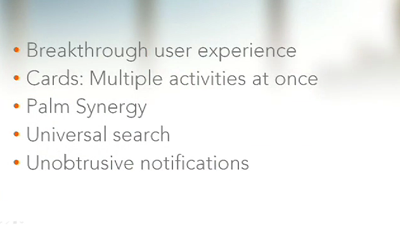
— Cards (like what iPhone does for multiple Safari windows) is the dominant UI pattern, so you can see multiple apps open at once, zoom in/out, close/arrange the apps around, etc.

— Spotlight-style search and launch just by typing something (kinda like LaunchBar, Quicksilver, etc.)

— Palm Synergy, goes beyond MobileMe, a cloud service that aggregates all your contacts, calendars, IM/SMS from multiple providers (google, yahoo, facebook, etc.)

— Launcher “wave”– a funky app launcher that floats like a wave :-)

— Unobtrusive notifications (phone calls, IMs, mail) — instead of iPhone approach (interruptive, center of screen, modal lock-out until you dismiss), appears at bottom, can be ignored while using another app, becomes iconified like Win system tray

More images from Palm here.

palm_pre_screenshot.png

Pixels and specs: you gotta deliver

While as designers we may wax poetically about the grand, noble ambitions of interaction design and user experience (shaping an integrated product strategy, cultivating a humanistic value system, advancing co-creative participatory processes and humanizing technologies, etc.) — for much of which our business/technology peers may express puzzlement or at least mild curiosity — the fact is that at the end of the day, a designer of digital products/services/systems is charged with a very basic (and important) responsibility: crafting the pixels that comprise the product’s UI and writing the specs that ensure accurate implementation for release. The designer has to deliver something of tangible value, to enable forward progress of the product’s development, and to be held accountable for it within the mundane yet necessary machinery of organizational rigor/process/bureaucracy.

Pixels and specs encompass the rigorous and necessary details that make a proposed product “real”, not just an ephemeral concept or elusive dream. The core challenge is to persist and translate the seductive vitality of those initial sense impressions of the “cool concept” or “breakthrough strategy” all the way deep down into the craft-production details, amidst what is assuredly a traumatic maelstrom of politics, bureaucracy, naysaying, broken schedules, under-budgeting, and rampant organizational dysfunctionality (hey, it’s just par for course, right?).

More than mundane requisite deliverables, they are yet further, vital touchpoints for shaping the overall design conversation with the product team and users…later stage moments part of that continuum of making the conceptual real.

But if you can articulate and drive the pixels (buttons, icons, type, colors, effects/animations, etc.) — even through the 37th iteration towards perfection — and subsequently document all that effectively, accurately, simply to your team, then you have achieved a major milestone as an interaction designer…moving from instigator and mediator towards enabler and builder…ultimately a creator crafting the most important aspects of a product’s fruition.

At the end of the day, despite the commonly repeated statements that IxD “isn’t about cosmetics, pixel-pushing, and button placement”, it’s the specs and pixels that define your value as a designer of the digital. You just have to deliver.

How to lose a designer in 10 days (proven to work!!)

OK, this is admittedly a bit snarky (ha!) but I couldn’t resist writing this up, after reflecting lately on my career thus far and the various shifts/changes along the way across companies. What are the common qualities that turn a job into something unpalatable for UI designers, driving them away even and souring those initially high-flying hopes/dreams? Here’s a sampling of issues, in no particular order.


** Immediate focus on “fixing the spec” for an already insane (or is it asinine?) coding schedule, rather than a collaborative approach of iterating designs, outside of the release cycle.

** Tedious, crowded review process with excessive mix of hoops and ladders (and too many reviewers in the mix). No clear distinction of owners, approvers, etc.

** The product manager doesn’t even know his own requirements or the customer-based rationale for a feature, when called on it. (yes, this has happened to me!)

** Meandering team meetings (Dev, QA, Doc, PM, etc.) with no agenda or focus, or takeaway action items, much less any resolution of project issues.

** Obfuscation of intention through senseless “corporate speak” (alphabet soup of acronyms, etc.) reflecting legacy thinking and irrelevant attitudes.

** A process (and culture) predicated upon excessive documentation, rather than fluid innovation and design-driven conversations.

** Put the designer on a project that is under her skill level or (worse) on a project that nobody wants because it’s a known disaster (poor coordination, scheduling, expectations management, assumptions muddied, etc.) that “has to be done” b/c of

** Have the designer spend more time documenting and analyzing rather than sketching, brainstorming, designing. Disproportionate balance of logical/emotional activities.


This may all seem pretty grim and depressing, but hopefully this provokes discussion amid the industry of how to properly set up a newly hired designer for long-term success, beyond the initial “honeymoon period” towards becoming a valued resource and truly loyal advocate for sustaining/growing the organizational culture.