
Core ideas of design

Straight from Dick Buchanan, as worded in his Interaction Design class syllabus:

“Design is an art of conceiving and planning products that are useful in supporting the activities of human beings in all areas of experience. Except in the area of crafts, designers do not make final products. They make prototypes and other visualizations, usually with supporting documentation that subsequently serve to guide manufacture and production.”

Continuing further about the nature of the profession of design…

“Design cannot be reduced to a fine art, engineering, or the social sciences without a significant loss in the richness, value, and utility of products. There may be strategic reasons for specialized work in one or another of these areas, but designers draw knowledge and insight from all of these areas in order to conceive and plan effective products.”

“Design is an integrative discipline, independent of specialized subject-matter disciplines. The vision behind this development is perhaps less evident than the visions that have reduced design successively to the fine arts, engineering, and the social sciences. But in the long term, the vision of design as an integrative discipline is more significant. Alliances between design and other disciplines will change from time to time as exciting new knowledge emerges in one or another field due to the contingent circumstances of research. But the essential advance of design–its ability to retain an identity and to incorporate new knowledge in the broader enterprise of design practice–will come from better understanding of the integrative nature of design thinking.”

And finally, the closer…

“Our department’s approach to design is fundamentally rhetorical in nature, in the sense that we regard design as a discipline that is based on the situatedness of products. This is a recognition that all products are situated in concrete, particular circumstances of human use, and that design must be a communicative art directed towards planning shaping human experience. The task of the designer is to conceive and plan products that are appropriate to human situations, drawing whatever knowledge and ideas are needed from all of the arts and sciences. For this reason we have identified communication and the human experience in design as the fundamental theme of the department.”

And one more thing :-)

“Design is an art of practical deliberation oriented towards shaping the argument of all products. The core of design, therefore, is an argument that integrates logos, mythos, ethos, and pathos. This argument is not expressed in words…they are vividly embodied in images, objects, actions/services, and systems.”
The 4 orders of design

Dick Buchanan postulated at CMU and in his writings that there are 4 “orders of design”, based upon product type and dimensionality (as well increasing complexity level and scope of influence). These orders map closely to the traditional commonplace labels ascribed to design disciplines, like graphic design or industrial design.

  • 1st Order: signs and symbols >> graphic design/2-D products
  • 2nd Order: objects >>industrial design/3-D products
  • 3rd Order: services and activities >> interaction design, service design/4-D (time or motion-based) products
  • 4th Order: systems and environments >> architecture, urban planning, organizational design, systems architecture, etc. (N-dimensional, multiple axes of concerns and change including society, government, community, public policy, law, natural ecologies, etc.)

For starters, it’s important to not get hung up too much on these labels, but instead to take a “topical” approach to what these orders may mean, as conceptual places for interpretation and invention, towards understanding their potential, both intellectually and professionally for the various design disciplines. There is no value judgment as to whether one order is “better” than another order. It’s simply a way to organize an ever growing and complicated field of activity.

What’s really cool is what interaction design and subsequent fields mean as places for design activity with post 3-D situations, dealing with people, time, motion, change, etc. Interaction design in particular is at a crucial nexus, as a novel and transitional field. There is a controversial (maybe for some folks) mix of principles and techniques from “yesterday’s design fields” (graphic design and industrial design) and “tomorrow’s emerging fields” (service and systems design).

For instance, typography, color, imagery, grids, layout all still matter greatly when crafting the well-formed engagement with a digital interface, whether it is a website, cell phone app, or your car GPS or even an electronic toaster. Those elements shape the message of the product and communicability of the interface to the user, just like a speech composed for an intended audience, swaying them towards some specific action or attitude.

In addition, high-level issues of social relationships, touchpoints for brand identity, feedback loops via customer service, overall architecture and flow through a system, must be considered just as important when designing a piece of software or other form of technology interaction. Increasingly, issues of public policy and organizational process “design” are taking on flavors of interaction/communication, within broad contexts of business and government–trending towards designs of the immaterial, shaping people’s relationships, behaviors, and values rather than distinct “products” per se on the shelf at your local electronics store.

It is this fascinating and provocative potential for interaction design thinking (with its inherent concepts and methods) borne from rhetorical traditions that i find the most exciting, in addition to the cool sexy rich interfaces and interactions, of course :-) Not just limited to websites or software or gadgetry, but influencing larger spheres of activity concerning people and their problems, in other contexts.

What is meant by “product”?

In CMU-speak, a product can be a lot of things. It has a very broad, liberal interpretation, referring to anything artificial, material or immaterial, resulting from deliberative human effort and planning, not just a piece of hardware or physical gadgetry for sale.

A product thus, in this sense, can be any of the following:

  • A map
  • A poster
  • A physical object
  • A website
  • A software application
  • A network device
  • An electronic gadget
  • A user interface
  • A complex system
  • A web-delivered service
  • A business process
  • An environment
  • An organization
  • A course syllabus, even!

When you look at the possible range of what could be a “product”, you can see there’s an extraordinary range of possible arguments and forms of rhetorical communication, as well as methods of thinking to solve their inherent problems. Each of these product types is a potential argument requiring different ways of handling them and presenting them to people. It should also be apparent that each one of these product types embodies a flavor of interaction design thinking, how people engage with the product and leverage it given a particular context or purpose.

Again, there is nothing inherently digital or web-based about product design, or interaction design. Once you’re able to accept this and start from this place as your baseline, it frees up your abilities and approaches as a designer, imho.

Original design thinking* = Rhetorical thinking

* “Design thinking” has unfortunately become an overused buzzword, adopted by Silicon Valley digerati and strategy fashionistas to refer to solving problems in a “designerly” way. I hope to clarify the confusion, focused on the canon of design thought at Carnegie Mellon in the mid/late 90’s – early/mid 2010’s.

Proposed and advocated by Richard Buchanan — as drawn from Classical rhetoric and his studies with Richard McKeon at University of Chicago, with a lineage going back to John Dewey — the humanist, strategic view of design thought is essentially about communication and interaction among people, ideas, values, and cultures towards a deliberated resolution of “truth”.

What is rhetoric? It has unfortunately acquired an unsavory meaning, commonly seen as contrived double-talk or sly deception through verbal sleight-of-hand, associated with sneaky salesmen and unscrupulous politicians. However, rhetoric was originally an art of persuasive communication, dating back 2,000 years, first formalized by Aristotle, as a situated art (a set of disciplined, systematic connnections to ideas and methods, all operating in the background of one’s mind guiding their attitudes and behaviors). So rhetoric really offers strategies to shape people’s actions and thoughts via language.

Going further, a rhetorical act involves communication between a speaker and an audience given a particular set of circumstances and a focus of discussion, or topic. (ah, that notion of topos again, a place for exploration and truth-seeking) Thus the core elements that define a rhetorical moment or situation are: speaker, audience, context, and subject matter. There should also be a purpose, or goal for the speaker to accomplish. And naturally there is a method, or set of articulated techniques that shape the delivery and presentation of the speech to the audience, to elicit a variety of responses. This involves appeals made by the speaker to the audience’s sense of logic, emotion, and trusting the speaker as well, per their sense of character and judgment.

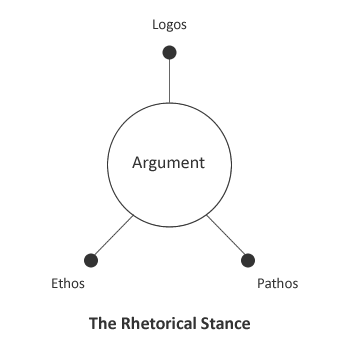
Unpacking this a bit more, a well-formed rhetorical act, or speech has three vital elements that constitute the argument put forth to the audience to interpret and respond:

the rhetorical stance

Logos: the logical, rational reasoning behind the argument, based on facts, evidence, data

Pathos: appeals to the audience’s emotions and sympathies

Ethos: a presentational style, conveying the speaker’s voice, tone, and character as deemed to be trustworthy/credible (or note) by the audience

Giving the argument’s overall shape is a sense of purpose or goal, guided by the context or place in which the argument is being made, and of course the various methods employed.

So how does this all connect to design thinking? What are the qualities shared between rhetorical thinking and design thinking as advocated by Buchanan?

  1. Focus on human-centric communication, recognizing the totality of the human being that is addressed with the “speech” (or designed artifact, in this case), not mere one-dimensional users or tools to be exploited for narrow goals. Strongly socially-focused, either at the individual or collective levels.
  2. A situational perspective, taking into account the variety of elements and circumstances that shape the communication and color the audience’s (or customer’s) perception: context, activity, task, goals, other people in the situation, other artifacts that arise, etc. It’s not just the speech act (or design) alone in a vacuum but the holistic view of all the interrelated pieces impacting each other.
  3. An integrative approach, not a piecemeal or episodic way of dealing with problems. Looking at how the logical structure, emotional value, and human factors fluidly influence/inform each other. Each builds upon each other and should be viewed together, resulting in a fully formed solution.
  4. Conversation is key. Dialogue and debate arise through communication and interaction with the audience. There are no absolute answers necessarily. Iteration and evolution towards some commonly/consensually agreed resolution is the mainstay.
  5. There is a necessary, effective sharing across other disciplines, leveraging knowledge and experience from other fields, ideas, or values as appropriate to make the positive effect upon the audience. So, multi-disciplinarity is a core aspect as well.

The rhetorical stance (quote)

Wayne Booth, “The Rhetorical Stance” (1963)

The common ingredient that I find in all of the writing I admire (excluding for now novels, plays, and poems) is something that I shall reluctantly call the rhetorical stance, a stance which depends on discovering and maintaining in any writing situation a proper balance among the three elements that are at work in any communicative effort: the available arguments about the subject itself, the interests and peculiarities of the audience, and the voice, the implied character, of the speaker. I should like to suggest that it is this balance, this rhetorical stance, difficult as it is to describe, that is our main goal as teachers of rhetoric.