The most important customer = the employees!

Without a well-trained, highly motivated, confident employee workforce it becomes very difficult to create and deliver rewarding products or services to customers. Those same employees are the ones who should be fielding inputs from both happy and unhappy customers to help guide successful outcomes for everyone in the ecosystem. If you care about your external customers (who pay money for your product or service) then you must care about your internal customers… the very employees that you pay (salary or whatever) to get stuff out the door! (and reinforce your brand promise as a symbolic delivery vehicle) Indeed, the “company” at the highest levels (meaning the executive leadership and senior-most staff, in the core domains of the company) must treat their employees as their most important customers, identifying their needs, reinforcing the value prop delivery, and ensuring successful outcomes. It’s more than simply keeping that particular kind of customers happy…it’s just as you would do for an external customer– amplify the brand, get the employees passionate for the company’s cause, enable their career path success, create opportunities for significant feedback and iteration, reward exemplary efforts, etc. 

 
For when an organization realizes that the employees are its first and foremost customers, then real customer experience magic happens. It takes a village, true…but it also takes a committed, valued, empowered team that feels respected and part of something larger to deliver to external customers. 

The future of IxD via New Yorker cartoons

I, as many people do, love the culturally savvy wit of The New Yorker cartoons. My adoration rose another level when I came across these two exceptionally relevant cartoons from recent issues, which humorously foretell certain challenges for interaction designers in the coming decade and beyond. 


Newyorker touchscreen

 
The first image speaks to the popular notion of younger generations (i.e., children) developing new mental models in their still-forming, impressionable minds and applying that everywhere, even where it’s somewhat absurd. But is it? I can’t help but recall Corning’s “Day Made of Glass” videos when I saw this cute image, and the implications that perhaps, a “basic” glass window could actually become amplified to serve as a touchscreen and more: What if I could pinch and zoom on a window glass to magnify what’s outside my window? Indeed the mad hatter of a heiress Sarah Winchester herself at her infamous mansion physically  installed windows with circular elements that were actually magnifying lenses so she could take a closer look  at guests approaching the property (she was a bit paranoid). What if the window were electrostatically & digitally charged up to respond to my touch and present contextual info, the equivalent of Google Glass with augmented layers of reality about the view outside: the weather, grass condensation level, UV levels, how far away is the UPS truck, where is the school bus this moment, etc. That child in the cartoon may be quite ahead of our times, with a host of interaction potential awaiting her.


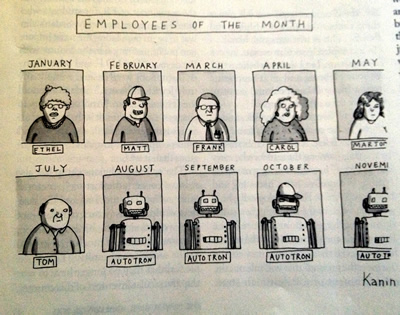
Newyorker robots

 
The second image also speaks to a common notion of robots taking over the workplace. Ever since the Jetsons with their robot maid Rosie, the popular idea that robots would someday do our most tedious, laborious work has become almost cliche. But now, from major manufacturing and electronics firms employing robots on assembly lines to having Roombas do our carpets at home, it’s not that far-fetched! And it does raise questions about a robot-driven labor force: labor rights, appropriate pay/costs, maintenance & upgrades, recycling and reconstitution of robots, equitable workplace with humans and robots, etc. A host of social and interaction issues pertaining to the co-location of artificial yet participatory entities that interaction designers will need to be mindful of. Will it be a future of robot vs human competition in the market, or one of peaceful cooperation and co-existence at myriad levels of social acceptance? This cartoon may paint the way at looking a bold robotic future.