
Scopes of consistency

What does it meant to be “consistent”? As I noted in a conf call last week with a VP of Prod Mgmnt, this can be a tricky, even dangerous word to use with certain audiences (ahem) like engineers who take it extremely literally. Yet this word gets thrown about a lot when talking about a “good design”, like a natural reflex. In our internal mobile UX summit last week, this issue emerged again in the context of designing a “consistent experience” across multiple devices by various vendors featuring different OS’s (Android vs iPhone vs Blackberry, for example). This raised in my mind the need to clarify this critical word, in terms of “scoping the level of consistency”.

First at a high level, I would suggest that “consistency” does NOT mean reckless cookie-cutter carbon copying of an element all over the place. Instead, to be properly, smartly consistent you must consider the context of use, and what is appropriate: visually, behaviorally, and linguistically (for terminology matters like labels and tip text) It’s like the difference between the rote memorization of a speech versus the rhetorical nuancing of an argument. It involves an art and balance of tradeoffs that requires deliberation among expert peers (and validation with users).

Digging deeper, there seem to be certain “scopes” of being consistent as well:

– Consistency with a visual design system such as Apple Aqua or Adobe Aeon or Microsoft Aero. At Citrix we have a system called Symphony that is a unique Citrix-branded look-and-feel with certain colors and type styles, per our brand.

– Consistency within a particular platform OS, such as iOS or Android or Blackberry which handle notifications and touch gestures in slightly different ways, as part of their “worldview”. When a user buys an Android device, she is buying into that worldview and all its joys and quirks. Ditto for other mobile platforms. In other words, “When in Rome…do as the Romans do” :-)

– Consistency within your product, regardless of platform or visual design system, declaring this is the way this product behavior works period.

Yet I have no answers :-) I am still not sure what the proper precedence level is among these scopes–it likely varies across teams and companies–but at least identifying them (and sussing out the critical threads that connect product designs together) will enable a productive debate about what’s truly most important and how to achieve a family feel.

At the end of the day, this is what matters–the voice of the products and their consistency in speaking a cohesive, balanced, persuasive tone to the target audience to encourage a positive experience overall. Evernote, Netflix, Dropbox, and Kindle Reader App all do this very well, as shown below:
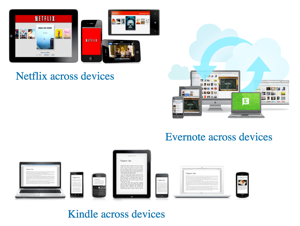
cross_device_heroes.png

And in doing so, achieving and persisting an almost intuitive sense of design integrity that is deeper than surface styles, but how much of a family relationship there is among the offerings. Kinda like “blood is thicker than water” ;-) That’s what consistency is all about.

Making Agile work with design

I’ve been meaning to write about my own experience with Agile for a long time! Such a persistently hot topic in design circles. After a great happy hour discussion with our peer Citrix Online designers–who function in a total Agile-driven enviro in Santa Barbara–I decided to share some thoughts from my previous Agile engagement.

** First it’s vital to understand that Agile is a development methodology for programmers, not a “user experience” model for designers. It was meant to achieve efficiencies in producing code as PM requirements change (which they inevitably do). It introduces the concept of “code iteration” and rapid collaboration on the fly–among programmers. That’s it. It’s not a panacea or a magic solution to everyone’s “lack of innovation” problems. Agile won’t give you an iPod. Agile won’t make your company the next Apple. Sorry.

Now that we’ve addressed that point, the big challenge is how to fit design into the often brutally short time cycles (sprints) and influence the stories (dev focus areas). Here’s what we did at Involution Studios with Andrei Herasimchuk when we were hired by a small software company called Agile Software (I know, it’s confusing :-) to help re-invent a product lifecycle management application from a visual, navigational, and behavioral POV with fully built prototypes and finished code.

1. Everyone was co-located into the same physical area. This included the Agile scrum-master, product manager, developers, tech writer, and designers. There were a few folks in India but the company flew out folks for several weeks at a time so that at some point everyone saw each other at least once a quarter for a sustained time period.

Being physically together is so critical to improved collaboration, communication, clearing up mis-understandings, whiteboarding on the fly, and of course, social bonding. Great teams require great chemistry, and knowing how to tap into each other’s rhythms. Also being together forced us to view the story list together, burndown charts, etc. Everyone is alert, focused, and “on-notice” in a sense. Overall just creates a nice vibe of being a true team with a common cause.

2. PMs and Dev leads were forced to learn Photoshop and create some mockups. No joke. Andrei had everyone commit to using Photoshop as the tool of choice for producing crisp pixel-accurate comps and final visual assets. This was decided upfront to eliminate ambiguity and mixing of file types, etc. Want good design? Gotta establish clear tools! In addition the non-design folks (lead PM and Devs) had to learn the tool to empathize with the issues of, say, making an icon or adjusting a layout so they realized how difficult it can be and the levels of impact.

Key Benefits: We never heard “can you just make a quick icon” ever. PM/Dev leads adjusted the stories and sprint cycles in recognition of the design time required for research / exploration / iteration / production. A far more sane, productive sprint cycle overall for designers and devs too. A happier collaborative effort overall. No feelings of being shoehorned into code-centric cycles.

3. Designers tried to stay ahead of the dev stories. This was key too, getting the designers ahead of the devs, to keep iterating on designs and buy time for exploration. Else the result would’ve been the force-fitting that drives designers crazy! More appreciation across the team for a continuous design process too.

4. Revisiting designs were part of the process. Everyone on the team recognized the need for revisiting designs as needed, per feedback internally or from informal user validation studies. This was factored in where possible, again thanks to that empathy for design fostered in PM and Dev leads.

5. Everyone was co-located in the same area :-) Just to iterate that point. It’s a HUGE benefit to have everyone in the same place talking and sharing and arguing and sketching together (at least ambiently aware what’s going on).

6. We had lunches together. Sounds very minor but it’s actually a positive social bonding element. Builds up the team chemistry and of course, those “water cooler” chats about design and dev problems, in a less intense situation. Openness of discussion in a non-threatening context is key! The sprints are intense periods of activity, so you need those down moments of casual conversation for what really matters.

7. We shared research findings and user validation results at our stand-ups and factored them into the stories, design changes, etc. So there was total visibility to everyone of what’s going on from that side of the project and it was given the appropriate level of importance, at stand-up calls.

We’re all mobile designers now

Having just completed a week-long internal design summit on mobile UX–and attended a very timely talk by Rachel Hinman— it’s become very clear to me that we are ALL in effect mobile designers now, or certainly within the next 2-3 years! Designing for mobile device UI is becoming the “new normal” for a variety of reasons as I see it:

• The rapid proliferation of mobile devices (phones and tablets and e-readers) among consumer and enterprise audiences…and don’t forget: TV’s at home, in-car GPS and telematics, kitchen appliances, thermostats, exercise devices, health/medical monitors, etc. The CES 2011 show unveiled over 80+ tablets from various vendors–they’re multiplying like rabbits :-) Yikes!

• The fact is every business is thinking (or freaking out :-) how to get on the mobile bandwagon with a version of their apps on iPhone/iPad, Android, and soon Blackberry and WebOS devices. (not to mention Windows 7 Mobile too!) Mobility is becoming the top strategic priority for firms, getting their apps on respective App Stores…kinda like how everyone just had to have a website 15 yrs ago :-) Funny how history repeats itself.

* Thankfully we have folks like Rachel and Luke Wroblewski to help illuminate the path towards good mobile design. LukeW’s presentation and argument for a “mobile first” strategy in particular is of note, focusing on the need to get ahead of the mobile curve which has positive impact on the software UI design itself–simplicity, focused feature set, clarity of functions–which hopefully rebounds back to the “full app” too.

• Cloud is hot. Yes, it’s the vague internet buzzword du jour–misappropriated in those lame Microsoft ads–but as Joe Biden would say, it’s a pretty “big eff’ing deal” l in which apps/data/settings/profiles are hosted “off-premise” or “out there” for access from any device, any place, any time for “on-demand” use…Just think of Google Mail, Docs, Apps. Amazon web services. Mobile Me. Salesforce. XenDesktop. etc, etc.

• Mobile lifestyles are becoming the norm with workshifting paradigms and emerging device-friendly generation uptaking these new offerings (Gen Y, Millenials, etc). From texting to checking-in to social networking on the go among a range of contexts: in the car, at the airport, on the plane, at a cafe, at the doctor’s office, etc. This is the new normal! As a result as designers we have to be mindful of dynamic environments of use–spatially, temporally, sonically, etc.

• On a related note, waiting is the new context to optimize for. Think about all the situations where you are waiting for something–at the grocery store, doctor’s office, DMV line, jury duty, car repair shop, etc. Combine this with the “need” (ha!) to be connected and productive somehow all the time…reaching for that phone/tablet/e-reader is almost second-nature! How this impacts our attitudes for a work/life balance and reading habits is a whole other discussion and blog post ;-) hint: the attention structures are rapidly changing, becoming more “chunked” and “modular” and “across-device”…hmm!

As a result of all this, UI designers today need to start naturally thinking in terms of cross-device mobile ecosystems for their interface designs: desktop > web > device > and back again. Functions and content should be optimized for the device being used, for the situations likely to be encountered yet retain a sense of ubiquity, fluidity, and of course brand personality that defines the entire mobile ecosystem of interfaces as an integrative aesthetic experience. Whew!

And also…at a technical level the big challenge is how to leverage your interface designs across devices and surfaces of varying resolutions (pixel density) without quite literally going insane! Optimizing tools, processes, templates with engineering teams will be key.

Indeed we are all now mobile designers who must contend with varieties of interface form factors and contexts. It’s simply inevitable and expected. So either get busy designing or get busy denying. But it’s happening :-)


What is value?

This question and topic is totally worthy of a doctoral dissertation or a lengthy cross-country motorcycle road trip with friends while confronting the ghost of Phaedrus :-) But for today’s mundane practical matters of designing a product that is valuable to a target audience, I’d humbly suggest value just comes down to a few basic, essential questions.

In my view, value is an immaterial, emergent quality that arises from a person’s interaction with something (physical / virtual / social) which clearly answers:

a) what task does this “something” help me accomplish

b) what goal does this “something” help me fulfill and

c) how does this “something” make me feel–the emotional benefit.

And…becomes something that enables a positive habit of use, weaving itself into fabric of living, working, playing, etc. to the point it’s necessary to a good life…while, of course, supporting the business too, not just in a financial value sense, but in a “gives the business a purposeful driver for its existence” sense, shaping its way into the life of ordinary folks.

Value in this humanist sense is about personal relevance, and meaning— at functional, social, cultural, even spiritual (or self-reflective) levels. The significance of a design is found not in the gazing upon the visual mockup, but in the daily engagement of the profound, incorporated in the pixels and atoms through the designer’s empathetic and aesthetic vision.

Value is found in convenience, comfort, assurance, empowerment, confidence, trust, safety, joy, and other personal aspirations that enable a “good life”.

What “value” your product aspires to deliver is the most difficult question to answer as that will drive the feature priority, the experience journey, the resulting outcomes. Indeed, what it is you are making! Just keep returning to the 3 key questions above re: task completion, goal fulfillment, and emotional benefit. And what is that central umbrella concept (like comfort or joy) that this product or feature promises to deliver? That’s the value proposition. Not some jargon-filled, committee-based awkward company statement that makes eyeballs roll. Value is what makes people love your product and believe in its ability to make their lives better.


Enabling a design strategy

Recently I had a chat with a lead designer from another software company, who asked “why have a design strategist?” and “what does it mean to have a design strategy?”. Good questions!

IMHO, I’m not totally convinced a company needs to hire a specific role for “design strategist” per se. In my view, that is the part played by your VP of Design, Creative Director, UX Director, and various other “design leaders”…which (as demonstrated by Apple, Dyson, P&G and Target) may also include the CEO! There must be someone driving the strategy–a comprehensive, forward looking direction of connected actions and outcomes expressed in a clear, strong vision–and everyone in key leadership roles should share in its dissemination and practice as ambassadors, advocates, stewards… and as doers, making design literally happen in their respective areas. This all propagates “design thinking” within and throughout a company’s rank-and-file.

Re: design strategy itself, my friend asked how I am specifically helping to enable that as a principal designer. I explained that for my role and our common team goals at Citrix, it involves three core planks or levers:

(Obviously this varies for each company, current circumstances and immediate goals)

a) Standards & patterns: Defining a strong, flexible visual and interaction design language common across products, with core components, widgets, patterns, templates for everyone to uptake and integrate to achieve a family feel. Truly, this defines the DNA of the main products, connected to the brand and central design values.

b) Education & outreach: This includes internal education efforts within the company to get people excited and informed about design process, outcomes, methods, etc. Also this includes reaching out to design schools for talent-spotting, building name recognition, co-sponsoring projects that can help guide internal projects, etc.

c) Creating new concepts: Want to create a great strategy? Build great products! Prototyping hi-fidelity concepts are the true surefire way to make a strategy visible, by provoking questions about what’s most important, and visualizing possibilities as compelling forms that can be validated and iterated upon.

Fundamentally, design strategy is about creating and delivering value, from a deeply humanistic POV that supports your business goals, and advances the state-of-the-art in shaping people’s lives for the better…while evolving your core mission, expanding markets/customers, and envisioning what’s next.

This requires heart, energy, vision, persistence, iteration, and smart collaboration, not a powerpoint slide deck or 3 hour meetings. It’s a shared commitment at the leadership level, that mobilizes and enlists the “in the trenches” workers at your company.

Â