Design forum with Norman/Maeda

Tonight I attended a rare and insightful conversation/interview featuring two of the biggest names in “Design”: Don Norman (no introduction needed) and John Maeda (ditto, currently president of RISD). Hmm, star power much? ;-) It was an uncharacteristically fully packed house at PARC’s Pake auditorium in Palo Alto. Clearly, there was a general expectation of something of interest arising out of this discussion! 

Overall it was framed as a debate between design and art, and the relationship to innovation. Exceptionally broad themes, of course, worthy of a 9 week seminar. Yet this was structured as a 90 dialogue and audience Q&A. Below are my main takeaways…

** Maeda, for his part, focused on “design doing” (rather than “design thinking” which he acknowledged has seized boardroom and buzzword consciousness), on what does design do exactly? For him, design is about “solving problems”, while art is about “making questions”. 

** The manipulation of content via typographic forms to convey mood, tone, tenor, voice. Maeda used “fear” as the content and demo’d how expressive presentations of varying degrees shape one’s interpretation of content. A fairly standard device for showing design’s persuasive power. Erik Spiekerman’s “Stop Stealing Sheep” does is beautifully in a short tome, published over a decade ago. 

** Maeda: “Artists find features, which they hold on to as references.” Points to the exploratory nature of discovery and inspiration that shapes the artist’s mind and eye as a lens upon reality.

** Norman began by identifying himself as an “interaction designer” but wondering aloud, what is an interaction, how do you design that, is it visible? He continued with his now-common critique of design education (Full article found here: http://www.core77.com/blog/columns/why_design_education_must_change_17993.asp ) 

** A key point echoed by Norman, which I firmly believe in as a distinguishing characteristic that separates a “designer” from a “design thinker” or other designer-types: “What you learn in design is how to draw”. He later replaced “drawing” with “sketching” to be all encompassing, towards prototype sketches as well. You learn how to visualize as a mode of thinking, analysis, synthesis, and generation, in a fluid hand-eye-mind manner. That’s essential to being a designer.

** Maeda’s response to Norman’s issues with design education: It’s about variety and role models, exposing students to a wide range of sources and opportunities.  It’s also about first principles and primitive systems/forms (chair, knife, etc.). 

What I found quite interesting was how Norman was very much interested in how “Design” can solve the BIG complex problems of systems, transportation, healthcare, etc. (3rd and 4th Order Problems, in Buchanan-speak). Meanwhile, Maeda was approaching it from the POV of first principles embodied in basic form/content/expression challenges. Maeda contended such massive complexity problems are not “Design” oriented per se, but more about leadership, society, and policy. Requiring higher levels of domain expertise and skills beyond what “Design” affords in the main. 

Another note-worthy aspect of the dialogue was Norman’s constant iteration of what it means to be a “great designer”. For example, a “great designer” makes the invisible visible, or perceptible. A “great designer” draws/sketches to think through a problem. A “great designer” doesn’t know much about the world but has the curiosity to ask why, how, etc. 

Norman also went on at length about different kinds of innovation, as iterated on his blog articles, specifically a) incremental and b) radical. The former being more common, while we romanticize and idealize and expect the latter, which is extremely rare and difficult to achieve. He emphasized that standard human-centered design (HCD) process amounts to basically “clever design by committee” that enables “hill climbing” but not great leaps of novelty. 

Referring to Apple, Norman stated that their big leap of innovation was really “systems thinking” around iPod and iTunes, not just a slick click wheel UI mechanism. There have been lots of portable MP3 digital players before the iPod (I used to own one, the Diamond Rio, which I bought at CMU Tech Store for $250 for a hearty 256 MB of storage in 2000 spring! yikes). The relative ease of transfer and purchase and playability of DRM content across devices in a unified ecosystem was the market-busting novelty. 

(A moment of classic Norman curmudgeony-ness: He said that he loves the iPhone but it’s badly designed b/c the gestures are non-discoverable…”swipe here, tap there, tap and hold someplace…who knows?” I personally disagree, as we’re still defining a vernacular of gesture, the patterns of which are being more established and learnable as pre-cognizant expectation with every quickly released app. Just ask a 12 yr old kid ;-) 

Maeda emphasized his point that “in any field, for innovation you must go back to first principles, the canonical thinking”, as personified in traditional design and artistic disciplines, for making chairs, knives, pots, etc. Form, content, expression, experience are essential ingredients. (Reminds me of John Dewey’s thoughts, which I’ve often championed)

Indeed, it’s the balance of both kinds of thinking, that enables innovation at varying scales. The real question is what challenge are you tackling, and towards what end? Norman and Maeda offering valuable points across the board for all designers to consider. 


Tackling conceptual “fuzziness”

Recently I’ve been involved in a few rather vague, open-ended conceptual projects at Citrix. Hey, it’s fun stuff for sure and certainly quite challenging. But what I keep coming back to is the structured manner in which I strive to collaborate with my non-design peers presenting this mothball of ambiguity for me to tackle. How do I go about dealing with all that fuzziness, as they unravel, in such a way that it doesn’t become overwhelming and confusing, thus getting lost in the process?

For the last decade I’ve frequently referred to Vogel/Cagan’s “Creating Breakthrough Products” for guidance on tackling what they authors call “the fuzzy front-end” of product development–trying to identify the core market, business value prop, and guiding design principles, to help ascertain a specific direction with certainty. It’s a great starting point and the advice has been valuable in giving backbone to my own assertions and decisions with skeptical devs/PMs at the office.

Lately, however I’ve evolved my own set of questions and approaches for tackling this fuzziness, in conjunction with the project leads from non-design domains. That’s what I’d like to share here briefly :-)

The key thing is what I’ve previously referred to as “3-in-a-box” partnership with the key leads representing UX, Engineering, and Management (or whatever labels may be applied). This is necessary for sustaining ongoing discussions, building rapport/trust, and ensuring efficient impactful communications towards resolution and planning for what’s next, post-ship.

With all the players in the room or studio together, then it’s really a matter of continual deep questioning and discussion with the designer serving as a therapist or facilitator ;-) For instance…

* What’s the premise? Summarize in a nutshell, short pithy phrase what’s your product/service about? Why should someone care at all?

* What’s the problem and/or opportunity at stake? It important to define specifically what is being addressed by what is being proposed. Is it compensating for some existing problem? Or is it anticipating an unmet need, a missed opportunity on the horizon?

These two initial questions are about the “Why“…as Simon Sinek famously extolled, you gotta start with “Why” first, before feature lists and use case inventories. Why would anyone, engineer and customer alike, even care?

Then from there, moving into:

– Who’s the primary user and market target? What’s their composition in terms of skills, experience, goals, fears, anxieties, dislikes, motivators, and worries. Draft out a persona that captures the essence. (maybe multiple personas, as needed) and capture specific “POV statement” (Actor needs X because of Y in order to achieve/fulfill/satisfy Z) which will help anchor and guide design solution iterations and evaluations.

– What are the key assumptions, dependencies, and expectations in terms of the user, devices, software, hardware, contexts, activities, and related elements? Draft these out and draw connections via insightful analysis and real observations in the wild (or on-site interviews). Too often we make unsaid assumptions that color our perceptions of what users truly want. Get all that out in the open! Debate and prioritize and clarify into a tidy list.

– List out the core use cases per market and design research (or at least an initial baseline via personal observations) and use them to literally write out a story/scenario that captures the actor, scenes, objects, actions, responses, and sequencing/frequency clearly.

– Consider the critical moments of device or UI interaction–what are the triggers, affordances, signals, feedbacks, and flows & errors? Illustrate them into “comic book” storyboards with notes about objects & actions accordingly. Call out special attention to potential problems and annoyances.

– Dive deeper into the possible interfaces for those key moments…break them out into lots and lots of sketches of possibilities: patterns, layouts, widgets, behaviors. All at high-level sketches, not pixels ;-)

– Reference back to your user/persona profiles and their “POV statement” of what they need to accomplish or support deeper motives/goals given a particular context. This will help ascertain which interface sketches make sense and are deemed “viable” vs “delightful” vs “breakthrough” (as basic criteria for selection)

Using this approach you can at least cut through some of the initial fogginess of a new conceptual project in a structured manner, avoiding lots of vague hand-wavy awkwardness of “what do we do” :-) Also ideally these steps should be reinforced with effective and constant user research based upon direct observation in the filed, as well as surveys, interviews, lab studies, etc. Always be learning and applying those findings to your ongoing design investigations to make forward progress through the conceptual fuzziness.


Design career path schematic

The other day I met with my boss to discuss my “career plan” going forward. Snooze, right? Could easily descend into a boring corporate dialogue, filled with trite, empty jargon and eye-rolling acronyms…blah.

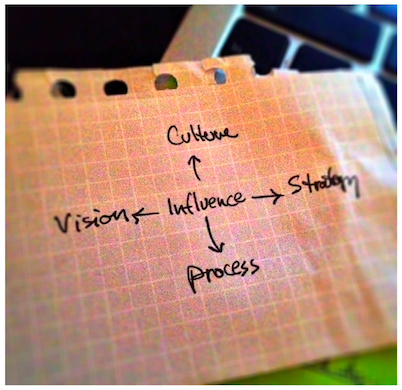
However, being a veteran of such drab contexts, I walked in fully prepared, focused on a substantive discussion, by presenting a simple yet powerful schematic that summarizes key “vectors of influence” which I see myself pursuing in an aggregative fashion over time, enabling me to gain valuable lessons and develop my repertoire as a design leader…not just in my current workplace, but also in the field at-large, applicable to a variety of contexts. Because in the end your career is what you make of it, and how you see yourself become what you seek. (sounds so Zen doesn’t it? ;-) What was this schematic and what are its core elements? Well, I’m happy to share, as I don’t believe it’s something to be withheld, but instead propagated to help other budding design leaders.

Career schematic 2012


This schematic is based upon the infamous “cross of pain” diagrams at Carnegie Mellon in Dick Buchanan’s Grad Seminar back in the day. The centerpiece at the heart is “influence”, in terms of shaping and guiding impact regarding problems & opportunities as a principal designer. As my first industry mentor once said to me, “Uday, what you need is influence. That’s the key to success as a designer.” It’s basically a rhetorical concept, in terms of applying language and perception towards advancing your aims in support of a beneficial goal for the team or company or the market. Influence is about framing and guiding, activities grounded in humanistic principles, not mere slick snake-oil manipulation (i.e., sophistry) but of progress, delight, and craft. Change for the better! Who doesn’t want to achieve that…it’s the essence of design itself.

So from influence, what are the vectors? Four simple yet major areas of impact within a company context (and applicable to agency or consulting situations as well), as described below:


Vision: What’s that beautifully articulated noble, magnanimous, ambitious concept of where we are headed as a company? What are the product or service design “moon shot” concepts, typically next-generation ideas, that push us further as a team, and help advance the company, even industry and society? What’s truly disruptive and game-changing that you are passionately enabling? How are you impacting that with workshops, brainstorms, prototypes, with emphasis on executive involvement? To be a design leader you’ve got to enable powerful visions of what can be, not jus incremental fixing existing pains…but leapfrogging and anticipating tomorrow’s potential.


Culture: How are you impacting and evolving the norms, values, principles, and general ethos that defines a team, department, and company overall…by virtue of your advocacy, evangelism, outreach activities, thought leadership outputs (books, articles, talks, classes), and training efforts. Are you making a mark in defining what kind of place this company is in terms of design excellence and the value of those efforts for the company-at-large, for non-designers like HR, IT, Finance, Legal, Sales, etc. To be a design leader you should be constantly nurturing and advancing the cultural design-oriented vibe of a place, whether it’s in-house design or an agency or even your client. Always be fostering design-mindfulness.


Strategy: Oh strategy…Such a nebulous and buzzwordy notion! But at the end of the day it comes down to a systematic, thoughtful articulation of how design is applied in multiple areas of the business in interdependent, integrative fashion, from products to marketing, services to branding to hiring. How is design manifested as a strategic conversation of deliberative intentions, versus a temporary policy of adherence and policing. And as a design leader, are you instigating, guiding, and resolving critical conversations with the highest visiblity stakeholders (i.e., executives) or simply reacting to short-order requests? Are you being proactive and anticipating “big picture” decision-points with multifaceted rationale (humanistic, technological, financial, etc.)?


Process: Designers love to discuss process, right? Well, this is more than simply speechifying “1-2-3” steps, but also effectively advocating, educating, and evolving processes to support general product & service development in a blended  partnership model, serving as a diplomat and ambassador for doing what’s right, fair, useful, and just…for the business and the customer. To be an effective design leader you gotta be a constant champion for ensuring better ways of collaborating, cooperating, sharing, and delivering powerful innovations.


Hopefully it’s become clear that these four central elements (vision, culture, strategy, process) overlap in many ways; indeed, they must in order for design innovation and progress to be made. That’s why, in my view it makes sense for a design leader to evaluate their contributions and influential impact along these “vectors of impact” and map out a career plan accordingly per these areas. This can help lead to far richer, engaging, insightful, and perhaps challenging conversation with your boss about what you really want to do, and how to mark out a path to get there. They set the beacons for helping to define specific, tangible actions and outcomes that can be itemized and evaluated for personal and professional progress.


Going beyond the MVP

A popular phrase of late (I think due to the wildfire-like spread of dev methodologies like Agile and Lean UX) is “MVP” or “Minimum Viable Product”…i.e., what’s the most basic release of the product for external use to gauge customer reactions, validations, learnings, so you can adjust quickly for subsequent iterations. It’s a baseline, something that’s of raw functionality, to embody the gist of what this brave, risk-taking, ambitious crew of engineers, marketers, designers has sought to unleash upon the world.

MVP = Not perfectly polished but “just enough” to make a small impact and provoke, inspire, catch fire (plus all the aforesaid Lean UX goals). Hmm, sounds quite a bit like Herb Simon’s infamous “satisficing” concept, doesn’t it? ;-) Just enough that’s necessary and sufficient to achieve some kind of pragmatic goal, to help focus and scope the very real tactical and tangible efforts of people, time, budget, resources…towards a very real target (that’s measurable and trackable). After all, all your product stakeholders (including investors, partners, vendors, suppliers, etc.) are deliberately taking a big chance with you and counting their minutes and dollars too. Whew! No pressure, right?? ;-)

However, while “MVP” is arguably a very practical structure to impose, I can’t help but feel quite disillusioned by this notion.

As designers we should be optimists! Why do we settle for the “MVP” as a “MINIMUM viable product” rather than aspire towards what I like to call, the “MAXIMUM viable promise”. After all, that’s what you’re really delivering, is a promise predicated upon your company & product brand, a set of expectations of what could be, that should dramatically shift customer perceptions and understanding of what’s possible by virtue of your offering. Imagine if Dyson, Nest, Tesla did just a basic “minimum” viability goal. They all produced something bold, powerful, inspiring, and yes still functionally viable…indeed it was the maximum viability given their constraints, compromises, conditions for their initial products.

Yes, we must ship something real and justifiably viable but still embodies the kernel of the soul, the essence of what makes it…what IT needs to be, distinctive, engaging, resonant with customer goals and values. That kernel may be expressed in terms of visual style, specific controls and affordances, overall brand and messaging, as well as raw brute-force functionality, expressed in their totality, with nuanced craft and quality. It should embody a promise of what should be, not just what can be built for expediency sake. Else you risk going “too low” and building something so minimally viable that it’s rudimentary, unimpressive, and basically a “so what” falling short of the reaction you truly want: exultation, gratitude, and delight. Aim for the promise, not just a mere product…this relates to the brand voice and perception, projected into the user’s mind and enhanced by their direct interaction with the offering you are creating.


Consumerizing the enterprise

So what does it really mean to “consumerize” an enterprise software product? This has become quite a buzzword lately, even spawning an entire conference around the topic in downtown SF a few months ago.

Indeed, Citrix CEO Mark Templeton has previously identified “three pillars” that serve as the foundation of our ongoing strategy of design excellence: simplify + unify + consumerize. The first two seem pretty straight-forward enough–simplify the literally thousands of options/menus/settings/features, and bring family-like coherence to the variously acquired products– but that last word, “consumerize”…Hmm! Is it just a buzzword to get board members excited? Is it more than simply making an interface visually “stylish” a la Apple or Metro (per whatever the style du jour happens to be)?

For me, “consumerizing” enterprise software has been a personal pursuit for quite some time, since my days back at Oracle, Adobe, Cisco, etc. I’ve always been inspired to inject nuanced humanity, aesthetic virtue, and emotionally resonant story into the tedious humdrum of brutally mechanistic business process systems. Why not strive to breathe life into work-based interfaces, and thus delight into daily routines? Why can’t work be fun? :-)


More specifically, to consumerize enterprise apps means for me…

* Basing product decisions upon modern, evolving expectations shaped by consumer interfaces and brands, particularly in terms of performance, usability, functionality, style, and story (the argument as to how this product or service weaves into my daily rhythms). From video game consoles to smartphones to home AV systems to in-car telematics–People are used to certain things at home, why not apply them at work too? Less to learn, more to enjoy! Makes sense, no?

* Regarding the “user” as an emotive, dynamic human being who seeks a meaningful, engaging life, not just a banal data point processed through arcane systems for pure efficiency’s sake. This goes for IT Admins too. Hey, they use consumer tech/devices too right? As a former mentor said, “There’s no such thing as enterprise users, because we’re all consumers.” Ask any IT Admin or Program Manager and they’ll almost always cite Disney, Virgin, Lexus, Ritz-Carlton, etc. as benchmarks for stellar experiences that respect the human being.

* Crafting elegant, beautiful Interface visuals that look like a million bucks. (Since that’s how much the company likely paid ;-) Yes it’s about creating a stylish, attractive visual language system that carries across device form factors and platforms in a compelling yet coherent manner. This shapes an emotional relationship that impacts perception of utility and value.

* Applying fast, fluid behaviors & animations, with visual feedback, which leverage modern, patternizable consumer widget sets and technologies (CSS 3, Javascript libraries, HTML 5, mobile touch frameworks, etc.). Again, it’s about achieving expectations folks have with consumer tech back at home, but for work too. Gotta be snappy and responsive everywhere!

* Shaping a friendly, approachable verbal language and textual tone that fits the times, culture, generation. Why sound like a draconian android from 1970s with arcane error messages or stern instructions? We should use wit and charm, and thus create a distinct personality that evokes the product brand in a positive, reinforcing manner, not some opaque scolding “system”.

* Considering the total, integrated lifestyle and life cycles of the user, her context, and primary activities across multiple devices and situations. Creating something that truly blends into the work / life continuum of productivity (what Citrix CEO calls “life slicing”), so it all doesn’t feel like “going to work” or alien intrusion that breaks apart the flow of activity with staccato moments of confusion, disappointment, frustration, etc. (This echoes John Dewey’s points about distracted experiences in Art as Experience)


Stepping back, in my view consumerization is influenced by the following factors, shaped by user research and design activities happening in concert:

– The Environment: locational context of use / types of devices / transient & emergent behaviors, mindful of people on the go, work shifting from non-traditional office spaces, etc.

– The Consumer: personal attitudes and expectations about the task, how it’s delivered, how it’s consumed, and thus useful in daily living (life-slicing metaphor) from a truly human POV, not some binary data processor.

– The Embodiment: visual interface style, interactive motions, contextual smarts, language tone, all add up to a compelling offering worthy of engagement.