Thoughts on “creativity”

Two recent items have sparked some deep personal introspection into the consistently hot topic of “creativity”. I’d like to scaffold my thoughts on top of them into some operating personal theory of sorts…

First, the SVP of Customer Experience at Citrix, Catherine Courage, brilliantly articulated a design executive’s perspective on inspiring business people to own up to their creative potential (which she argues is a “birthright” of everyone, not just a select few). She described various conditions and qualifiers that enable creativity within businesses, like building a physical space, following a design process, embracing iteration and risk. Catherine’s TEDx talk is really quite good and worth your 15 minutes!

No doubt, having an executive (including your CEO and executive leadership team) advocating for the right conditions, backed by money, people, and tools/methods to materialize the results, is essential to fostering a culture of creative thinking and increasing the probability of breakthrough solutions. Without executive support you’re simply doomed to fail badly or suffer ongoing disappointment and attrition of talent.

Second, I saw this question on Quora asking for a succinct description of the “creative process” into just a couple sentences. Dave Malouf, renowned design thought leader & teacher, supplied a thorough multi-step explanation of how a creative process unfolds, based upon user-oriented design thinking, with observation and insights manifested via synthesis, models, stories, conversations, and iteration towards a result. Excellent!

Incidentally, that reminded me of a quote in Managing as Designing: “Creativity needs a design process to structure it, giving focus on humanistic aims.” There is an order to the madness that provides coherence and constraints, not just “100 monkeys with typewriters” trying to come up with Hamlet…ostensibly grounded in user-oriented motives and themes (via empathic methods). 

So, organizational executive-backed conditions for creative activity …Check. A descriptive, structured process based on user-oriented goals…Check. 

But there’s gotta be more to it, right? Yes, there’s the neurological element of synaptic connections, feeding your consciousness (“priming” as it were) with tons of data and context, having heroes/mentors to train and offer confidence and guidance, tools and methods of execution to manifest and execute the results. Anything else…? 

I believe all that is for nought (or only yields perfunctory results) without heart, soul, and passion. In a word, you gotta believe. It takes a personal commitment, that feeds into the collective team. The power of belief complemented by the struggle of overcoming, guided by focused discipline (habits, routines, sources) that shape and engender, truly bringing alive, your creative potential and powerful outcomes–that’s the golden key IMHO. Any “cultural creative” (musician, artist, writer, etc.) will tell you that it’s quite difficult to be creative “on demand”, very taxing emotionally and spiritually, while also uplifting and rewarding. There’s a bit of a heroic quest in being reluctantly drawn to the creative endeavor, anticipating some vague vision, working through the grind of making it happen and potentially failing in a very big way, encountering tremendous resistance by others, too. There’s incredible risk and fear and hope and joy. It’s a powerful roller-coaster of upheaval and delight, towards the final deliverance of a awe-inspiring outcome, shared collectively with a team and individually. There’s the consequence of growth, renewal, achievement that results from a truly creative act.

The struggle in particular is essential, as this is where one’s integrity and authenticity comes to bear, staring down the twilight of one’s soul in the depths of midnight itself (at 2 am usually), banging your head against the table (or the team becoming frustrated, questioning the merits of this escapade, this risky jaunt of a trip), and powering ahead through it all, via sheer force of heart and will, believing (“trusting the process” as d-schoolers often say!) that this darkness will give way to the emerging light of imagination, lighting a spark in the individual or collective mind, that blazes with a fury inexhaustible of all creative possibilities towards final resolution and delivery…and even then the embers glow on, smoldering yet ready to be re-lit for the next creative challenge.

It’s that gut-level stuff of heart and soul vividly manifest in passionate effort that enables “creativity” to transpire at all, resulting in something everyone can be proud of, and reap the benefits. 

So, what does it take to “be creative” for innovation efforts back at the office? Executive support, user-oriented design process, and passionate, soulful belief to achieve. Simple, right? ;-) 

In defense of chrome

I like visual chrome in UI…and I’m betting many designers secretly do too ;-) In the current (circa 2012) mood of anti-chrome dogma (i.e., skeuomorphism hate, fueled in part by recent “lust of the new” infatuation over Windows 8’s informationally ascetic aesthetic–which, BTW is still unproven among users) this may seem like a radically outdated statement. After all, a UI that’s so rich you “want to lick it” is just so 2001, right? Well, not so fast folks…

“Chrome” (not the Google browser ;-) unfortunately has taken on a negative tone of something that’s overdone, gaudy, mawkish, anachronistically applied visual flourishes for gratuity’s sake, not applicable to (and perhaps even interfering with) a digital product’s functionality. And just flat out “tacky” to some. I mean, who wants that??

Well, if done improperly in such silly ways (which is NOT new…remember Kai Power Tools, anyone born before 1980?) then YES, visual chrome can lead to just that effect of ostentatiously getting in the way. After all, design should always be invisible, right? Except when it shouldn’t be. 

What about visual affordances that offers clues as to the existence of and potential use for a feature, like a page curl revealing layers of functionality or (gasp) a button or (face palm ) a menu? Pulling in learned knowledge from physical metaphors into the digital space is not a sin. It helps with discovery, understanding, learning, and adds (if done well with subtlety and sensitivity) delight to digital austerity. Ascetism is great for monks. Not so much for complex products armed with layers, spaces and modalities of capability to be found and used. Especially when we have devices loaded with 30+ apps all trying to be cute with gestures and no basis to come back to. 

Chrome provides an anchor, a framing element to the space, actions, and content, with clear lines of demarcation, so you’re not tapping all over the place wondering what’s “active”. Nicely done headers and footers and sidebars, etc. can house primary controls, navigational aids/cues, and of course branding, thus creating a distinct space of meaningful value. A oft-stated concern with Windows 8 style is getting lost in a floaty, never-ending space of content, losing where you are within a seamless, unfolding infographic. Seams can actually be useful, not shunned.

Chrome enables place-sensing: where the hell am I? and how do I get out? what do I do next? And with animations and subtle touch/swipe gestures we can do even more compelling and useful anticipatory digital actions like peek, reveal, depth effects, etc. Thereby adding joyful moments, and balanced utility, creating a product that’s more than a Swiss poster infographic–as fetishized as we elite designers like to make them out to be. Posters are useful, but we’re talking about full-blown digital products and services, often within multifunctional mobile devices.

Some say this all contradicts the notion of “being authentically digital”. I say chrome enhances and augments what the digital space can be, bringing vitality and utility together, if done well. So instead of being gratuitous distraction, visual chrome can add value to an interface; simply a matter of finding that “sweet spot” of balance between affordance, content, functionality, discoverability…and delight. 

(Side note: there’s an underlying issue of “taste” here. Of course, certain textures, styles, treatments simply rankle folks the wrong way and become annoying. The faux leather in iOS Contacts and Calendar apps come to mind. I agree that could be done much better ;-) But it’s important to discern personal taste preference from functional intent to augment the interface’s capabilities, tackiness notwithstanding.)

Repeat after me: Visual affordances are a good thing. Subtlety is poetry. Nuance is elegance. Let’s make digital interfaces more than authentic but awe-inspiring. Chrome can help and shouldn’t be dismissed because we’re suddenly tired of it thanks to a new Window to stare at, or a few bad Apples…if you’ll pardon the puns ;-)

Bumper sticker design

It’s fun to re-tweet nifty design phrases we come across while surfing around. Hey, I do it all the time! We find nice  zingers or deep maxims that seem to speak to something we individually or collectively behold. Some aspirational phrase by Jony Ive or stern admonition by Paul Rand. But it’s another thing to actually use that as the basis of design decision-making and trumpeting it as dogma back at the office (or within a design community), with little understanding to the historical context and motivation for that phrase…like “form follows function” (Louis Sullivan, written in 1896 essay stating his views on Modernist architecture as a departure from organic decoration, in the context of new technologies enabling the skyscraper’s advent) or “good design is little design as possible” (Dieter Rams, proclaimed as part of his 10 Principles of Good Design, which interrelate and integrate, shouldn’t be cherry-picked just to use one or two for when it’s convenient). These are popular ones often thrown about in arguments with designers and engineers as credos and laws. Another favorite is “design should be invisible”. Really? Is that why you noticed the beautiful interface of Path 2.0 iOS app or Flipboard’s elegant origami-esque UI pattern? Oops, gotcha! 

Now, it’s not horribly bad to throw around platitudes, but the big risk is that ill-informed or inexperienced designers take these things literally, even blindly, potentially negating their design work & credibility…possibly harming client relationships. It’s a problem that I call “bumper sticker design”, tossing about fun platitudes that are not well-considered for their initial purpose or relevance, nor deliberated for their applicable extent of value and consequence (which takes judgment and experience). There’s a tendency to accept such a platitude as fiat (Hey, Eames said it, so it’s gotta be right all the time, right??) and apply it as such. An absolute law. Just like political bumper sticker slogans that simplistically–yes, I mean that phrase, not “simply”– distill a campaign position into some fun, pithy catchphrase that becomes a sensational buzz, bypassing any substantive discourse, exploration of exceptions/parallels, and thus useful decision-making…like, who should I really vote for and what policies and principles are really at stake? But I digress. 

Let’s do our part as serious designers and avoid simplistic use of such catchphrases & platitudes as weapons in design arguments or laws thrown at a design problem (or worse, at an unknowing non-design stakeholder to whom you’re just trying to appear “smart”, but merely badly worn condescension). If we come across something that we think is meaningful, resonates with a value we hold, let’s explore it further, dig deeper into its origins, apply that learning and yield a more enriched understanding that enables a productive dialogue and decision-making, particularly amongst non-designers. 

Oh and I’ll still keep re-tweeting interesting design quotes and phrases of course ;-) Helps add to our knowledge. But debating and questioning adds to our understanding and effective use over time. 

What is an educated designer?

I recently had a nice chat with a former design prof about what makes for an educated designer these days. I graduated over 10 yrs ago from CMU’s School of Design with my Master’s, so it’s interesting to look at today’s crop of incoming students and emerging design leaders. What are the expected work experiences, toolkits, grades and scores, etc. All that has evolved per raised expectations and changed parameters (i.e., GRE scores, web-based toolkits, social service and “alternative” work experiences and travel opps). But coming out of all that, what does it mean to educate a designer and then even lifelong, what’s that journey ahead in gaining education? What does it mean to be an “educated designer” these days…and beyond?

There’s simply a balance of past, present, and future, in my view.

** Historical understanding of ideas (origins & evolutions) and techniques (manual, non-digital). You’ve got to understand how things have come to be today, based upon earlier theories, practices, movements, schools of thought, etc. Else you’re doomed to repeat mistakes, look foolish re-applying former approaches inappropriately, and simply lack proper appreciation for how and why we do what we do today, and as we extend into the future. A brilliant short example of this is Mike Kruzeniski’s reference to paper/print/type for the future of interaction design, influencing the creation of Metro visual design system as a truly novel, authentic competitor to iOS. 

Also you need to understand how the things we take for granted in Photoshop and InDesign were done in “the olden days of yore” with manual typesetting and letterform drawing, manual laying out of paper elements and photography. It’s a matter of appreciation and thoroughness of understanding to be a complete designer. Sure there’s Kuler for creating algorithmically correct color palettes, but performing color studies with paper and paint heightens one’s sensitivity further. And of course, sketching will never die, despite the advent and popularity of digital tools on iPad, etc. Basic pen, pencil, paper skills are vital even more, IMHO.

** Liberal arts basis of thinking: literature, philosophy, art history, etc. As a designer drawing inspiration from disparate, complementary or orthogonal sources, you gotta be a polymath of sorts, with ever evolving appreciation for various subject matters, and be able to dive deep enough to interpret and leverage that for problem solving. Simply adds to your arsenal, making you a cultural creative conversant in the grand scheme of life itself, or at least with other designers when brainstorming ;-) 

** Current events and media/pop culture. Gotta stay hip to the times, not just latest cool tech gadgets, but also what’s relevant and fashionable. And how those topics refer back to historical patterns and trends (borrowing form liberal arts basis, describe above…see how it all ties together ;-) And of course social, political, economic factors going on now and near future. What are the trends, situations, events, and general attitudes overall. 

** Current tools and methods of making. Still need to make stuff, even if you are in “design strategy” or “design thinking” roles! Knowing how to craft highly resolved solutions in their various embodiments and expressions is vital to securing and developing your credibility as a designer, period. Keeping up with tools is essential for this, with ongoing practice trying them out, doing projects, etc. 

** A pulse on the future. Voraciously absorbing what’s on the horizon in terms of trends, patterns, trajectories, scenarios, predictions, etc. from fashion to politics to new theories and products/services. What are emerging social norms and generational lifestyles/attitudes to prepare for? What are ethnographers and anthropologists and psychologists discussing?

And keep taking classes on new things…improvisation, negotiation, social entrepreneurship, writing a business plan, refreshers on history and philosophy, etc. Keep the mind sharp and agile!

Whew, that’s a lot! At the end of the day, however, I keep coming back to a fundamental core value for a truly educated designer: adaptability and willingness to “unlearn” so as to “learn the new”. Having a strong liberal arts-based design education myself, I believe that’s the key to honing your ability and becoming a total, well-rounded, 360 designer prepared for a lifelong journey of evolution and success in Design.

Recap & highlights: UX Australia 2012

This year I had the grateful and honored privilege to speak at the annual UX Australia conference in Brisbane on a Citrix success story, based upon our newly introduced “3-in-a-box” model of collaborative dev (slides publicly available here on Dropbox, 42mb PDF). Below is my conf recap and highlights…

Overall the conference was a very well done affair, nicely proportional and structured for a regional event, supporting ~ 350 attendees with a balance of workshops, keynotes, 45 min talks (as dual tracks in side-by-side ballrooms), and quick “lightning round” 10 minute talks…and of course social events! Held at the conveniently situated Sofitel in Brisbane’s CBD, the conf was well worth the 15 hour flight with lots of good nuggets and stories of design thinking & doing! 

Bill DeRouchey kicked things off with an inspiring keynote around the necessary and sustained questioning of “Why”, despite changing tech and processes and problems (related to Simon Sinek’s “Start With Why” book/TED talk). Also went further, extending the notion of “empathy” with “compassion” (via the Dalai Lama), suggesting we need to have “genuine interest” in people & contexts to be truly effective designers of worthwhile impact. Designing with compassion! Hmm.

There were several success stories of design innovation and collaboration as well, which was heartening to hear. We’ve become so used to hearing “learning from failure”, so it’s nice to relay positive anecdotes too: mobile apps, “big data” information design, banking interfaces, even the Australian Post news redesign. Many of these nicely conveyed in the 10 min quick sessions: http://www.uxaustralia.com.au/uxaustralia-2012/10minute-talks-2

A couple talks I enjoyed were on the more alternative, edgy side of things (shades of SxSW perhaps? ;-) which grabbed my interest strongly. For example, a very heartfelt, sensitive ethnographic journey into the lives and minds of graffiti writers and street artists–how should you delve into such a subculture while preserving their anonymity, your personal safety, and deliver useful insights and solutions? Or dealing with your online presence after you die..what happens to your content and data? Some tough questions with no easy answer but thoughtful reflection is needed. Both were quite fascinating!


Uxa collage s1b


Stephen Cox’s entertaining and touching take on the anthropological mindset for designers inspired a deeper sense of “being human” and enhancing human abilities through our methods and tools. Gotta absorb that curiosity and genuine interest for humanity to be a better designer!

Quite a few talks around collaboration and innovation from various perspectives.

Steve Baty offered a compelling set of exemplars for innovation, encouraging attendees to avoid taking the easy way out, and instead “be bold, ask extreme questions, think big” to pursue something like a Nike Air, Yellowtail wines, etc. Be disruptive! (and consider the ecosystem, your stakeholders motives)

Jeremy Yuille took a different approach, examining design as performance (not theater per se ;-) but distinguishing amongst pragmatic, critical, and enterprising performances (ways of demonstrating, acting) in design. Most interesting to me was the relationship between “ambiguity” and “affinity” in terms of problem discovery and framing and solving. Good intellectual stuff, also speaks to innovation.

A couple speakers delved into the need for design process transparency for stakeholders, citing various lessons learned and tips for keeping cross-functional teams all informed about design progress. Another spoke of the near-symbiotic relationship between design and development, and championed the cause for greater ties to devs who want to achieve high-quality products. 

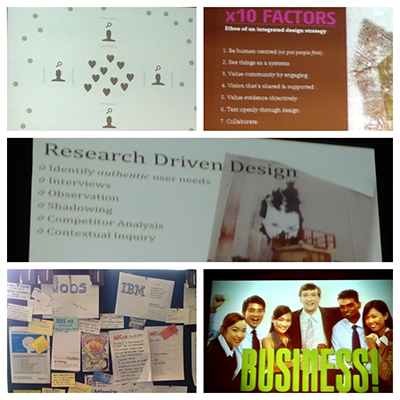
Finally, the closing keynote was a valuable, inspiring demonstration of a regional govt.’s desire for design thinking in public policy and urban re-design, further extending the promise of “user experience” from digital interfaces towards entire service-driven ecosystems and cultural design itself (i.e., the 3rd and 4th Orders). Kudos to the Adelaide govt and Integrated Design Commission for raising hope that design can lead to resilient, productive economy and civic exchange!


Uxa collage s2b

There were other many useful, memorable, engaging talks and presentations but these are just the brief key highlights from my view. I look forward to hopefully attending UX Australia in 2013 at Melbourne! Cheers…


Â