On designing with execs

Executives are kind of a funny lot. Not all are trained to be group collaborators yet coordinate with very strong personalities. Most are driven by fact-based proven statistical metrics yet want that elusive charm/desire factor for buzz and sales. Many speak of brand values of the company yet make agonizingly tough decisions that seem counter-intuitive, impacting the team or product. Whew! How in the world do you design with or for these folks? It can be a trying experience for the unprepared, no question!

Yet having the memorable opportunity to engage with executives to debate concepts and shape customer experience strategy…well that’s simply priceless! You want to make a great impression at the table, so to speak.

Below are a few lessons I’ve been quietly capturing lately, per recent experiences on various projects with execs:

Assert your point of view. You’re there for a reason, take advantage! Make your informed opinion known. That might mean talking over them and “elbowing” your way in a bit (many have strong points of view themselves to assert!) but they will respect your direct, candid perspective. (Corollary: Don’t apologize, ever, for anything. Simply assert and focus, very briefly. Execs are time-pressed!)

Simplify and explain the concept like to a child (not that execs are child-like, of course ;-) Use visuals! Avoid the temptation for geeky “design-speak”. Use various familiar analogies and metaphors, particularly from pop culture or everyday objects & tools. 

It’s ok to disagree, with defensible credible rationale. Beware: “because It’s cool” is not a useful rationale (unless speaking strictly of style trends)! There will be merciless disagreement if you say that. Be objective and reasoned.

Don’t attempt to wear hats you’re not qualified to wear, like marketing or engineering. If you don’t know, admit it and request proper inputs from those peers.

Many execs love to sketch and visualize their ideas! Let them and then leverage that for productive discussions. Poke holes and raise critical issues (respectfully ;-)

– They want specific, tangible, immediate ideas and actions, not abstractions or theory. Keep that at home. But explain the principles behind your suggestions, framed by concrete examples with real data as much as possible.
Going beyond just “validation”

It’s typical among Lean Startup adherents to speak of “validation” and “customer development”, as part of the rapid iterative build-test-learn cycle inherent to the Lean philosophy. Formed an assumption about the customer? Validate it. Got a new hypothesis about the problem? Validate it. Exploring some delivery tactics via a fake website? Validate it.

Validation is the heart and soul of Lean, pushing the product team brimming with self-created enthusiasm “out of the building” to speak with actual people to gather their feedback, reduce risk, and ensure success before moving on to the next decision point.

However…there’s a small problem with the word “validation“.

Looking closely, it implies an exactitude of guaranteed correctness, that you’ve got the right answer, so you can successfully move forward. You can almost hear the stamp going “thunk” on the paper, with the certification of proper results, as the team smiles, knowing that they “got it”. This attitude presupposes a correct definitive answer, can constrain the ability to see fringe ideas, and inhibits openness to new possibilities unforeseen during testing. 

As anyone knows who has gone through not just design, but also the fuzzy front-end of product innovation, there are no predictable guaranteed outcomes, due to the dazzling array of uncertain variables and risk factors beyond your control.

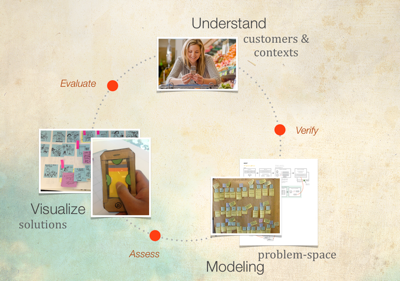
Besides, all data (quant or qual) must be taken with grains of salt due to the contexts of the feedback sessions. Therefore, instead of singular “validation”, it’s preferable to break down this nearly ubiquitous phrase into the following concepts, that map to primary phases of a user-centered design process, as shown below:

3partcycle

After understanding targeted customers and contexts, then Verify your personas and scenarios with actual users and other stakeholders to ensure accuracy of perceptions. (Like the old adage, “trust but verify”)

After creating diagrams and taskflows/wireframes, then Assess your models of data interaction and information architecture with Product Managers and Engineering leads for completeness of capturing and representing all the relevant tasks and objects and functions, and such. This can also be assessed with targeted users with proper framing of the activity and what’s to be shown.

After producing some solutions, then Evaluate such visualizations and/or prototypes (of varying degrees of fidelity) with targeted users through properly framed feedback sessions to catch usability problems, missed features, and other forms of improvements. 

These terms point to a more nuanced sense of “validating” what’s appropriate for your targeted market and context, as an ongoing process of learning and understanding and thus, innovating. It’s going beyond simply a convenient stamp of approval (“validation”) but creating a dialogue of realization. Inventing solutions is a journey of seeking, not a singular moment of final absolution. It takes several rounds to get it moving on the “right track” towards satisfying users ;-) 

Quick reflection: Design as a confidence game

I don’t mean a “con game” whereby someone is getting swindled out of a proper deal and left holding the bag. I mean, there’s a game of coordination and competition amongst stakeholders (Biz, Tech, Marketing, etc.) with diverse (or perhaps at-odds) interests, priorities, goals, agendas that must be somehow mutually enabled into some harmony of purpose and value. For the designer, this often requires tough, smart, negotiated compromise while striving towards an ideal vision of what’s best for the users and the business. And this means, as the designer driving the (user-oriented) end of the deal, you must be confident in your approaches, speak with a voice of conviction (“Have a point of view”, as Citrix CEO Mark Templeton likes to say), and design capably with a sense of ambition to carry the team and company forward, not simply settling for “low-hanging fruit” or “table stakes”. Marshaling a vision that encompasses the widest range of criteria yet addresses the sharpest, focused needs of a distinct persona can be incredibly difficult, and it takes a strong dose of being confident to instill confidence in the team members striving to achieve what seem impossible. However, you must also have the humility and self-awareness to step back and realize when not to overstep your place on the field of play. Sometimes certain levels of accomplishment take more time and slower progress than expected, with small battles cast aside in service of better collaborations.

The most important customer = the employees!

Without a well-trained, highly motivated, confident employee workforce it becomes very difficult to create and deliver rewarding products or services to customers. Those same employees are the ones who should be fielding inputs from both happy and unhappy customers to help guide successful outcomes for everyone in the ecosystem. If you care about your external customers (who pay money for your product or service) then you must care about your internal customers… the very employees that you pay (salary or whatever) to get stuff out the door! (and reinforce your brand promise as a symbolic delivery vehicle) Indeed, the “company” at the highest levels (meaning the executive leadership and senior-most staff, in the core domains of the company) must treat their employees as their most important customers, identifying their needs, reinforcing the value prop delivery, and ensuring successful outcomes. It’s more than simply keeping that particular kind of customers happy…it’s just as you would do for an external customer– amplify the brand, get the employees passionate for the company’s cause, enable their career path success, create opportunities for significant feedback and iteration, reward exemplary efforts, etc. 

 
For when an organization realizes that the employees are its first and foremost customers, then real customer experience magic happens. It takes a village, true…but it also takes a committed, valued, empowered team that feels respected and part of something larger to deliver to external customers. 

The future of IxD via New Yorker cartoons

I, as many people do, love the culturally savvy wit of The New Yorker cartoons. My adoration rose another level when I came across these two exceptionally relevant cartoons from recent issues, which humorously foretell certain challenges for interaction designers in the coming decade and beyond. 


Newyorker touchscreen

 
The first image speaks to the popular notion of younger generations (i.e., children) developing new mental models in their still-forming, impressionable minds and applying that everywhere, even where it’s somewhat absurd. But is it? I can’t help but recall Corning’s “Day Made of Glass” videos when I saw this cute image, and the implications that perhaps, a “basic” glass window could actually become amplified to serve as a touchscreen and more: What if I could pinch and zoom on a window glass to magnify what’s outside my window? Indeed the mad hatter of a heiress Sarah Winchester herself at her infamous mansion physically  installed windows with circular elements that were actually magnifying lenses so she could take a closer look  at guests approaching the property (she was a bit paranoid). What if the window were electrostatically & digitally charged up to respond to my touch and present contextual info, the equivalent of Google Glass with augmented layers of reality about the view outside: the weather, grass condensation level, UV levels, how far away is the UPS truck, where is the school bus this moment, etc. That child in the cartoon may be quite ahead of our times, with a host of interaction potential awaiting her.


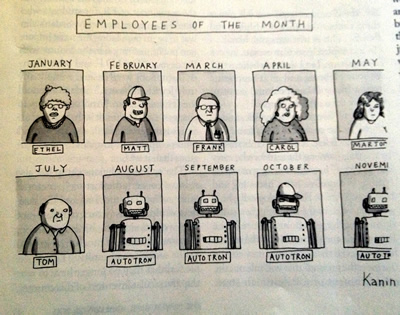
Newyorker robots

 
The second image also speaks to a common notion of robots taking over the workplace. Ever since the Jetsons with their robot maid Rosie, the popular idea that robots would someday do our most tedious, laborious work has become almost cliche. But now, from major manufacturing and electronics firms employing robots on assembly lines to having Roombas do our carpets at home, it’s not that far-fetched! And it does raise questions about a robot-driven labor force: labor rights, appropriate pay/costs, maintenance & upgrades, recycling and reconstitution of robots, equitable workplace with humans and robots, etc. A host of social and interaction issues pertaining to the co-location of artificial yet participatory entities that interaction designers will need to be mindful of. Will it be a future of robot vs human competition in the market, or one of peaceful cooperation and co-existence at myriad levels of social acceptance? This cartoon may paint the way at looking a bold robotic future.