What is good design?

Ah, the perennial question of what it is exactly that characterizes and establishes “good design”. It seems non-designers in particular are more enchanted by this question (i.e., engineers and managers) and its potential answer, for it begs (from the mere phrasing) a specific, repeatable, verifiable formula / recipe/ prescription that guarantees successful results… Every. Single. Time. Well…

Seasoned designers, of course, know better than that. There is no formula. There is no silver bullet. There is no magic answer that guarantees outsized profits, mesmerized customers, or a miraculous “Steve Jobs” halo of gamechangery.

What I’ve learned over the past dozen years of practicing design among a variety of companies (agency, big corp, small studio) is that “good design” is really an attitude, a posture, a mindset, rather than a guaranteed formula for repeatable success. It is a structured yet adaptive manner of empathy, sketching, collaboration, creativity, prototyping, iteration, more prototyping, more iteration, constant feedback and placing deliberate bets per calculated risks according to the market, the technologies, the untapped needs, and ultimately the core values of the company, as embodied by the executive team. Those are the most critical factors that enable a “good design” to materialize and commercialize, not some 1-2-3 stepwise formula. Every situation is different. What works for Apple or Tesla or Nest may not work for your market or industry. But the persistent needs of empathy, creativity, prototyping, iteration, feedback are the anchors for what can enable a good design to emerge and transpire. 

So what is “good design”? It’s an attitude of design-driven excellence (from strategy to delivery), a process of iteration and creativity, a mentality of enabling humanistic achievement for people, and a value system grounded in excellence of craft with a magnanimous bent towards what’s best for customers: appropriate, empowering, delightful. What that means in terms of the particulars of execution depends, but that’s actually a good thing. There can be no one “right” way. This plurality enables the uniqueness of possibility, the returns of potentiality, not some generic formula of mass utility, a vanilla whitewashing. Through the diversity of what constitutes good for different audiences lies the opportunity for cross-pollinating innovations and exchanges of ideas, ever more progressive cycles of creativity. After all, isn’t that what “good design” that enables humanity’s progress should be about anyway? 

Conf Recap: MIT EmTech 2013

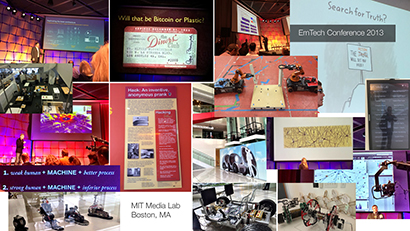
This year I had the cool opportunity to attend the annual EmTech (Emerging Technology) Conference sponsored by MIT Technology Review, and held at the distinguished MIT Media Lab in Boston. I’ve always wanted to visit the Media Lab, as celebrated hallowed ground technical wizardry, and took full advantage via the event ;-) Not only were the various TED-style conference keynotes held on the topmost floor of the Media Lab, but there were also behind-the-scenes tours of MIT’s many labs with demo stations and models/prototypes, as well. 

Conference attendees even got to test drive hybrid Porsches out front for 20 minutes! (clearly a sneaky ploy by one of the big corporate sponsors–I had fun ;-) 


Mit collage fw flat mini


MIT Tech Review’s media roundup of EmTech citations:
 
Below are my top highlights & takeaways from the 3-day conference. 
 
1. Steve Case: The legendary founder of AOL did an on-stage interview with Joi Ito, the Media Lab director. Case emphasized taking a “long slog” view of building Internet-driven companies (citing his own history with AOL, hitting IPO after seven years, but not reaching critical mass until 8+ years after IPO, achieving 150 billion valuation). He’s currently focused on Wash DC policymaking, fostering entrepreneurial contacts, backing immigration policies, etc.
 
– Look outside the usual areas for investment opps: examples are Chobani, Zip Car, Zappos, Under Armour (not all hi-tech either)
– Build a “flywheel of innovation” via Talent + Network Density effects. Hmm.
– “Constructive Engagement” with government is vital, they are “the largest customer”! Can’t just ignore govt.
 
2. Deb Roy: MIT prof, founder of Bluefin Labs, which was sold to Twitter. He’s now Chief Media Scientist at Twitter, described his “love of words”, using various data visualizations to show correlations of Twitter key phrases to TV watching patterns (shows, movies, live events). Basically an analytics platform that defines a “Content Graph”. Described Twitter as a “public live conversational medium”. Interesting…
 
3. Kate Crawford from MS Research on “Big Data”: Described three areas we should all ask about “Big Data”:
– Doubt the myth of objectivity: All data is subject to complex context, data is a function of human interpretation (which involves personal creativity)
– Data discrimination: How does data modeling predict behaviors fairly?
– End of anonymity: we are in a new era, where the corporate selling of data is common, understood, well-known. Personally identifiable info is pervasive & inescapable.
 
4. Human-Computer Symbiosis: Speaker from Palantir spoke of his personal belief of achieving “intelligence augmentation” via cooperative strengths of humans + machines. Handling resourcing allocations (factory) to adaptive complex situation (war) to Rogue trading and credit card scheme tracking. Ultimately, the UI that people use must be familiar, performant (fast), and expressive of our desires. 
 
5. Brain-inspired computing / Neural processing: A set of talks dealing with this fascinating space about “the brain”. Qualcomm speaker spoke of their efforts at neural processors and architectures that replicate human brain, with software tools (IDE, debugger, runtime simulations) now available to use! “Zeroth” computing inspired by Asimov.
 
– Others spoke of “neuro-engineering”, which involved cognitive implants and very heavy talk about memories, dreams, realities. A synapse is actually a tiny powerful gap between neurons. Cognitive prosthetics for helping brain damage persons, replacing sections of the brain (hippocampus). Mathematical representation of the brain’s memory functions. Seems very Inception-y!
 
6. Shell Oil speaker: Standard “sponsored speaker”, rather defensive about Shell’s innovation programs. He spoke of the “stress nexus” among food, water, and energy as all being interconnected and having multiplier effects on human pop and climate changes. Described various “clean tech” innovation efforts from Shell, via “TechWorks” program with MIT. Hmm. Skeptical.
 
7. Healthcare Policy: Chief Economist from GE Healthcare described using Maps, Models, and Games to intersect “Big Data” with huge wicked problems beyond human capabilities.
– Maps: to visualize and understand an abstraction
– Model: to project an interpretation for discussion
– Games: to solve with “fun” angle of competition and cooperation
“The metrics you choose will determine your goals/outcomes” Be careful! Hmm.
 
8. New tech mishmash: Various talks on topics like Digital Currency (Bitcoin in particular), 3D Printing (self-assembling entities via sensors and motors–very cool), Smart Cities (via IBM) about sensors everywhere for tracking and modulating conditions like traffic, water systems, road repair indications, etc. (MIT has the “Senseable City Lab”–very cool urban data viz featured)
 
Also notable: There were several short 3 min talks by “Under 35” inventors sprinkled about. Here’s the full listing: http://www.technologyreview.com/lists/innovators-under-35/2013/ (Coolest one: 28 yr old MIT grad created a nuclear rector the size of a beer keg for processing nuclear waste back into usable fuel! )  
 
Disappointments:
 
— Very disappointed in the talk about “future of education” which was focused on “Gamification” trends. Snooze. Seems like a tired meme, nothing groundbreaking in terms of methods and models. 
 
— Surprisingly disappointed in the talk by Google’s Mary Lou Jepson, head of Google Glass. Basically a PR talk about how cool Glass is, nothing about the process and motives or prototype failures along the way. She also had a slide saying (no joke) “ID and UX are mostly styling”. I quickly chastised her on Twitter for that. (Oops, there goes my future job at Google! ;-) 


Conf Recap: UX Australia 2013

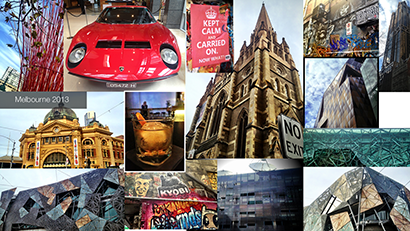
This year I was fortunate enough to be invited back to present again (yay!) at this very well-executed regional conference for the Aussie UX community, held in Melbourne and encompassing about 500 attendees. When not rehearsing & speaking (whew!), I attended a range of short and long talks across two parallel tracks. Below are my “top of mind” highlights and notes. Enjoy!

**Note: Slides and audio recordings will be posted online in a few weeks, per the organizers’ announcement. Stay tuned!  If you are interested in my talks, here are Public Dropbox links to PDF files: 

a) Innovating gestural UX

b) Designing with executives


Mel collage 1 flat mini


Main talk highlights

Keynote: Microinteractions
Keynote by Dan Saffer, based upon his fantastic new book titled the same. While wicked problems are undeniably a big deal, so are small moments that encapsulate a rewarding (or frustrating) interaction with a product or service. Think about “signature moments” that extend your brand, and interactions that encompass triggers + rules + feedback + loops/modes. A nice cheat sheet of principles here.

Doing Co-Design
– Involving stakeholders early in the design discovery process is valuable for pragmatic & political reasons
– Also increases probability of innovation with fresh outside perspectives
– Variety of tools (via Liz Sanders) to help sensitize (enable self-reflection), immerse (in the topic space), and generate solutions
– Organizations must be ready to allow users to influence the direction: willing to let users define things, desire for real change, ability to resource it, commitment to follow-through 

More info here (in terms of Service Design tools): http://www.servicedesigntools.org/taxonomy/term/1

Cultural Probes for UX Project
– Probes are package of artifacts to enable evocative tasks
– Case study of mobile workstyles analysis via Telstra telecom provider
– Trying to understand devices + contexts + tasks employed
– Probe kits involve diaries, cameras, specific sets of tasks with questions on aftermath of task
– Goal is to gather unique insights (beyond user interviews) and build visual evidence of real users/tasks

Here’s a fun flickr compilation of probes: http://www.flickr.com/groups/probes/

Behavior Design
– Using Zappos as a model (unique job “non-offer” by offering candidates big $$$ to NOT take a job)
– Create offers and decisions that evoke or capitalize on “cognitive dissonance” of action and expectations
– Consider how to incorporate this into designing products/services, enabling desired behavior

Art of Thought
– About book written by Graham Wallas in 1926
– Describes four stages of creativity: preparation, incubation, revelation, evaluation
– Just like design process, but how to compensate (or charge clients) for “incubation” phase?
– Made the point that clients are really paying for a 24/7 brain that creates value, much of it not explicit, fairly implicit (reminds me of “good design takes time” ;-)

Here’s a nice overview of the 4 stages on Brain Pickings.

Frictionless Navigation
– What does it mean to design a well-crafted navigation system?
– Some critical attributes: optimal location, clarity, proportion
– Speaker showed examples of how web or mobile navigation targets are too small, obscured, minimized, hidden (page/screen navigation controls, progressive disclosure of content & functionality)
– Consider device awareness (variable screen sizes/responsiveness)
– Also consider: rethink navigational elements in gestural world, lazy loading elements, auto-balancing of content that is intelligent per user/role/context/device

Models of Innovation
– Inspired by Dan Hill’s book “Dark Matter”
– Two basic models proposed
– 1) insight-led innovation: based upon standard UCD model of user research studies, evaluating multiple concepts, iterating on feedback, emphasis on observations (empiricist)
– 2) hypothesis-led innovation: drawn from personal frustrating/pains (a “felt difficulty”), similar to Lean models of product creation based upon assumption about generalizing personal pain to validated market (but might be totally wrong!) Lotsa questions: is the market right? is the product right? is the feature right?
– Not a value judgment as to which is better, but good to clarify the positions, arrive at criteria as to which is useful, appropriate given various conditions & outcomes

One Team, One Dream
– How do you fit various cross-disciplinary designers and engineers into a single dedicated team?
– Proposed a 3-part assessment of personalities and working styles
– Three parts are:
a) How do you process information: internally (like to absorb it all together) or externally (like to discover along the way)
b) Orientation to change: explorer (out of box thinker, challenging norms) or developer (like structure, authority, incremental changes)
c) Decision-making approach: person-centric (resolving conflicts, making folks comfortable, relationships) or task-driven (get it done, fix problems, etc.)

Cross-Cultural Gesture Study
Very fascinating look at “pointing” vs “semantic” gestures for controlling TV, comprised of 360 participants from 18 countries. Full study report is here: http://www.uxfellows.com/gesture.php

New Media, Interactivity & Aesthetics
Fascinating overview of the history and cultures of creating provocative projects that embody the concepts of interaction and expression. Artists engaging with electronic devices and screens to create “something” that elicits emotive and physical reactions–before XBOX Kinect or Nike FuelBand! Everything new is actually quite old…

Someone posted a cool comprehensive sketch note here.

Product Definition via Lean UX & Design Thinking
Great overview with case studies of how Lean UX can be an effective model for generating and evaluating hypotheses, blending with “design thinking” applying rapid iterative prototyping-oriented methods, even remotely across time zones.


Other random thoughts…

The following triggered by various talks and discussions and/or questions by the audience. 

– We now have 3D-printable human prosthetics (arms, hands)–what’s next? Building your own Frankenstein Terminator? Hmm.

– About 3-5 people is the ideal team number for ensuring constructive productive sustainable collaboration. After that things break apart, or at least harder to manage.

– The UX profession has lots of “lies, shams, deceptions” and half-truths/stories we tell ourselves. Need to dig deeper for the truthiness/reality of the practice. For instance, “mobile is not a thing, it’s all just interaction design” or “social is really just a loose confederation of UI patterns”. Hmm. Dubious but interesting.

– Applying “universal design” for touch/gestural UX is important: reduce tolerance for error/mis-fires, requires low physical ergonomic effort, should be flexible across devices/screens

– The experience of a service delivery matters, not just the process of service delivery. Value is emergent and generative, co-creative in the activity.

– Re-designing a massive government website is like any web effort, has extra political stickiness. Focus on components, principles, prototypes. 

– Wearables are hot, makers are king, meetings suck, “good design” requires strong execution from engineering too.


“Place” for mobile UX & design culture

Place is a deep concept rich in potential–particularly in relation to “mobile workstyles” and creating a culture of design. Indeed, my own fascination with “place” as an amorphous digital concept goes way back to a pivotal course at CMU taught by Malcolm McCullough on “Place-centric Design”–much of which served as fodder for his landmark book Digital Ground (which I highly recommend).

 —————————————————————

Does place still matter in the modern era of “mobile workstyles”?

As a UX community, “mobile first” has become the norm. From the consumers’ POV, who are now armed with multiple devices and web services, “going mobile” is a de facto expectation as well. What does this mean in the context of “mobile workstyles”, whereby workers can truly be untethered from their cubicle or office, and work from any device, at any time, and any where? How does this impact the notion of “place” for a mobile worker–the evolution of its value, utility, and general qualities? Does place truly matter any more?

Well, of course place matters, but in novel and challenging ways that we’re just beginning to scratch the surface, physically, experientially, and even socially. Place becomes more of a temporal, activity-based construct, contextual per informational and behavioral goals, not just physical implements. It’s emergent, not persistent. It’s dynamic, not static. It’s pervasive, yet uniquely shaped by individual and collective needs. It’s virtual and yet retains analog qualities of personality and communication.

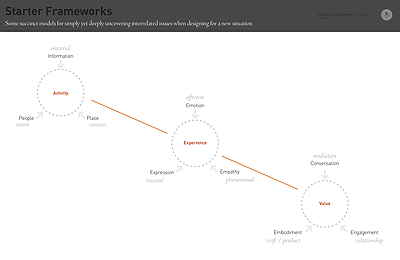
We need to explore such questions in the context of designing complex, interrelated cloud, social, mobile apps, enabling a “mobile workstyle revolution”–where people do their work anytime, any place, on any device. For example, what does it mean to access your files from anywhere, and share them (securely, of course) with anybody. Or interacting with your virtualized Windows 8 desktop (running legacy healthcare apps) on an iPad. Or holding video web conference call on your laptop, then move to the phone, while pulling in contextual information on your shifting presence and location? There are new models of information, interaction, and interface required. The technology landscape is changing swiftly, and our notions of “place” in this bold new world of “any-ness” demand critical re-interpretations of what’s productive and familiar to successfully design what’s next. Looking at the relationship among Activity + Experience + Value may pave a path forward…


 —————————————————————

Creating a place for design excellence: Culture, Process, Strategy, Leadership

When most folks think of enterprise software, images come to mind of confusing, complex apps that frustrate and annoy, built by tedious committees lacking empathy for their users. Alas, this is still true for much of the IT industry. However, four years ago, Citrix (a 24 yr old IT company founded in South Florida, of all places!) set on a path to break away from such stereotypes and revitalize their legacy IT products and culture through design.

Indeed, it’s interesting to note how Citrix has enabled a physical and cultural place for design-led innovation, starting with our hallmark 2,500 sq foot Design Studio–extremely rare for an enterprise software firm! As well as various “pop-up” studios across geographic locations, including UK and Bangalore. Every studio embodies rich cross-disciplinary activities, yet also a cultural attitude and approach for making user-driven change, grounded in principles (Simplicity, Empathy, Craft, Value) and habits (sketching, observing, interviewing, prototyping). For example, instead of engineering docs tossed to over the wall to designers to “make them pretty”, we advocate a “3 in the box” model with ongoing transparent collaboration. The studio has also become a conduit for creating a network of Design Catalysts, spreading design-based approaches amongst departments. Finally, it’s important to note the organizational places that design occupies within a 9,000 person global company, across tiers of design leadership: corporate executive (SVP), department director (Design Director, etc.), and individual contributor (Principal). Many humbling moments are often encountered–failure is expected! And it’s always a struggle to make change happen–you can’t “boil the ocean” but you gotta go where the suction is. These few essential elements (studio, catalysts, process, leadership levels) should offer hope to those leaders striving to create veritable place for design excellence within their own organizations, that’s more than just beanbags with MacBooks and fun toys ;-) 

Thresholds of design decision-making

Lately this word “threshold” has appeared in my readings and co-worker discussions. Threshold may be to be a very potent concept for designers to bear in mind. While principles serve as aspirational touchstones and lighthouses to guide a team towards what’s appropriate with deeply held values/goals, thresholds help with the reality of decision-making, gauging various levels of acceptable compromise.

A threshold is a kind of transition space, a crossing over (just like from room to room), from acceptable to not, risky to not, costly to not, failure to success, but with varying degrees of latitude along a continuum, not a strict binary either/or choice. It’s like a sliding scale for paying for a one-act theater performance, but how does one know what’s acceptable for a collective shared effort? And how is that point determined–through singular fiat or team vote? Thresholds help with choices, and design is all about making choices (or decisions). Sussing out the threshold for a team or project is not easy, but principles can help structure the overall conversational trajectory.

Thresholds appear when there’s that moment of uneasiness, awkwardness, or tension in the room about a decision, where it’s not obvious how to proceed, in terms of making the “right decision”. It’s very fascinating to see each stakeholder, via their own perspective and biases, brings their own level of thresholds (not to mention the actual threshold variables themselves): the Project Manager cares mostly about resource/scheduling, the Business Manager is focused about costs and markets, while Engineers are concerned with complexity, feasibility and risk, while UX looks at appropriate pleasure/pain levels for users, per user goals and contexts.

Often these are the types of issues that arise in project planning and design reviews that have a threshold factor:

– What’s the level of acceptability for…
– What’s risk/benefit in pursuing…
– What’s the level of pain users will tolerate…
– Are we getting enough value from this feature-add, what’s the acceptable cost…

Stakeholder maps (aka actors/ecology maps) and bullseye diagrams help as specific design methods for visualizing these conflicting tensions and anchoring conversations around such sensitive threshold moments. 

Again, there’s no one right decision or standard formula/prescription that can solve this. A threshold is not some magic number or found in a book. Arbitrary numeric scales, holding a “game” where each person has “tokens”, and so forth…such methods might help in the short-run. But each situation and question must be evaluated on their own merits, per shared or accepted values and principles. Thinking about thresholds might hold the key to a better compromise where the ideal state is unattainable, but with traversable difficulties.