Navigating around the imperious “No”

Contending with stiff constraints, often resulting in a watered down design vision, is a common burden all designers face. It’s a major source of friction, having to deal with the inevitable frustrations of hearing “No” from engineers ground down by “death march” schedules or nervous managers highly reluctant to address risks. Often the designers’– themselves worn by frayed nerves— respond with an impassioned, “Why can’t you…” or “Why is this so difficult…”

Such questions just persist the frustration and antagonism of an unhealthy conflict, perhaps even painting an unfair shade of whininess upon designers who simply wants a vision delivered per spec. I mean, is that so wrong?

Well, I have learned (quite painfully at times, I admit!) to handle such situations by raising questions that enable a more constructive, collaborative approach while poking into the flexibility of these constraints…

1) “Help me understand the issue”: I know, this isn’t really a question per se, but it’s an invitation from the designer to the engineer (or manager) to start a mutually beneficial, educational dialogue. Offered genuinely, it suggests a desire to want to learn more about the issues, conveying a sense of empathy, and strokes up the other’s ego a bit, now being seen as an expert whose knowledge is sought. Also, this phrasing gets everyone talking, thus listening and understanding, not accusing and defending, resulting in hostile vibes. A far more personable, complimentary approach than the accusatory “Why can’t you build this”.  Conducted well with healthy skepticism (the five why’s, etc), this dialogue can lead to discovery of underlying issues of a business or organizational nature, not just stubborn programming matters.

2) “What would it take?”: This is simply a re-framing that turns an accusatory, defensive questioning  into something far more productive, as a problem solving exercise to achieve the implementation goals. Again, it’s an invitation by the designer to empathize and learn about the details, encouraging everyone to brainstorm options to achieve a desired result. Then everyone can have a smart negotiation around precisely those success factors: schedule, budget, resources, skills, tools, etc. And perhaps even a revisit of fundamental purposes and principles, which is not a bad thing at all when tempers are high. 

3) “What if we…”: Finally, offering hypotheticals shifts everyone into a mindset that is exploratory and optimistic. Of course, with tight schedules and related pressures, minds close down into deeply myopic views of what’s feasible right here and now. And there may be just resistance. However, a tentatively offered “what if” prompt opens up unseen options, shaping a problem solving dialogue engaging the team’s creativity. For example: Maybe we don’t have to build everything this release but we can prioritize on two features, while we beta test a third next quarter. Again, this approach might involve a revisit of project goals and values. 

As you can imagine, these tactics can and should be used together in various ways, for collaborative exchanges with the team. After all, not every denial is truly an absolute  roadblock, but might be a desperate, hidden invitation to dig deeper into unseen issues everyone is simply too stressed to confront at the moment.

As designers, we can enable such crucial conversations that lead a more constructive relationship, ultimately for the customers’ benefit! After all, isn’t that why we’re all working so hard on this project, for this deadline? 

** Note, my assumption here is that we’re all dealing with rational, mature adult professionals on a team. Seriously, if folks react badly to these tactics, there might be some deeper personnel or project management issues! ;-) 

Success factors for delivering “Labs” value

So what is it exactly to truly be a “Labs” entity, functionally and strategically? It frankly seems to be a bit of an overused buzzword last few years, appending “Labs” to a company brand to somehow convey a marketable quality of something techie and… vaguely innovative ;-)

Well, after some reflection upon my own experience this year working with Citrix Labs on specific projects, touring MIT Media Lab recently, and learning more about other top-level corporate labs like Disney, Mercedes, Google, etc. I’d like to share my thoughts on what I believe makes for a vital, creative “Labs” environment with strong business impact. 

Here are some aspirational qualities common to the more successfully oriented Labs environs:

** Has a willingness to try, experiment, risk anything, fail at everything, bound by a strong “Can-Do” optimism of exploration. Instead of traditional naysaying of a product engineering group, the instinctive reaction to novel ideas is “Sure, why not?” and see where it goes…

** Deeply embodies a “hacker ethos” of rapidly creating quick & dirty prototypes to demonstrate raw functionality, as a starting point for further investigation of UX & business potential.

** Is constantly hounded by the question: What’s the most efficient way to prototype the intended functionality and get it in people’s hands for evaluation? (As Eames advocated: “the most with the least”) This requires lots of shortcuts–Searching for open source libraries, frameworks, scripts, etc. 

** Has tons of tech brilliance and polymathic curiosity for anything and everything, from “genetic algorithms” to “solar race cars” to “nanobots” and beyond, including the mundane “everyday engineering” of how things work. Such a team should be like a diverse mix of sharpened, perfected instruments on a surgical table, skilled at a variety of tools, methods, and approaches.

** Continually learning and growing by virtue of constant experimentation on their own, surprising others with new tricks, not just “what’s due next week” but always hungry to explore and foolish enough to try “dumb hacks” that fail (echoing Steve Jobs’ advice). 

** And, certainly not least: This is the team that PULLS the rest of the company forward into the unknown, assuming risk with enthusiasm for what’s possible. Not an anchor that weighs down, but a rocket that shoots upwards. (think of a “moonshot” directive)

** Finally, has strong ties to business model canvasing of the invention, with market-oriented experimentation as well, with customer development activities (Lean, etc.). Else the bold invention sits idly by! Gotta adopt a “3-in-a-Box” approach with verifiable commercial potential. 

IMHO when several of such qualities start to fade and disappear, that’s when a corporate “Labs” team is no longer the vanguard but devolves into a bane of mediocrity, rather than a benchmark for future prosperity. Ooh, a bit harsh to say, I know ;-) However, as you look deeper, this is all not just about “Labs” per se, but the broader innovation function within a company. For any company to achieve innovative results, the aforementioned qualities, propagated deeply amongst the employees, will increase the probabilities of success, hence earning the label of “innovation”.

At the end of the day, a major part of a “Labs” (or more accurately, innovation) capability and thus mindset is how to support that notion of big risk adoption, united with the creative, expressive nature of a strategic Design function. In the intersections lies the power and opportunity. Such an endeavor requires earnest partnership, bounded by a strong yet flexible process and shared complementary values, in order to deliver viable creative innovations for targeted markets.

Designing to achieve “magical impossibility”

Today I heard Ben Davis of the Bay Lights public art project describe his process of achieving something that I dubbed a “magical impossibility”— overcoming a situation fraught with maddening concerns of donor financing, complex structural engineering, regulated maintenance tactics, homeland security, and the intra-city politics of obtaining permits. Whew. And yet! Through luck and persistence Davis was able to find the right artist to enable his vision of a “canvas of light” modulating along the intensely variable SF Bay Bridge (winds, traffic, weather, fog) to great acclaim. The result is nothing short of magical, in its mesmerizing illumination of “giant pixels of light” that defies truly daunting practical matters. As Davis explained it, the project’s success depended upon many hands-on conversations with planners and engineers, backed by imaginative prototypes that showed the vision–thus forcing naysayers to shift towards an engagement of “How can we make this happen”. Yup, prototypes matter and can spin up the momentum to enable a vision to become real, corralling the necessary peer support…even for a massive public art project that rivals the scale of 8 Eiffel Towers!

Another point that stuck with me was Davis’ approach to compromise: “I will not compromise but I will be very grateful for your generous support”. Hmm! I like it. That saying suggests to me that taking a positive, “pay it forward” approach to engendering the team’s generosity to believe in and make his vision real is far more worthwhile than the typical back-and-forth exhaustive “death march” of cutting a vision down to a bare minimum of feasibility that satisfies nobody. Who wants that? Indeed, to achieve “magical impossibility” it takes hope, generosity, belief and damn good vision backed by indefatigable persistence. That’s when something truly awe-inspiring happens! Simply gaze upon the Bay Lights to see the proof. (see also: Tesla, SpaceX, Google Glass, Nest, iPhone, etc.)

Optics and pragmatics: The politics of design

One of the toughest lessons I’ve been learning as a corporate design leader is the political nature of designing, in terms of the actual activity of shaping a novel form or behavior that overthrows an existing model. Hey, it’s some scary stuff for people used to doing things a certain way :-) 

First let me clarify. By politics, I don’t mean long knives sneakily sharpened by duplicitous faux allies. I’m instead referring to the constant argumentation over resources and priorities and agendas–which is a conversational ebb and flow, resting on shifting subtleties of flawed personalities, not deftly wicked impulses. There is a factual limit to the number of hours, people, funds, tools, and so forth that can be committed to a design endeavor. And dutifully, such people in charge of this resourcing seek purposeful, transactionally sound, pragmatic resolution, a balance of aims to achieve satisfying compromise for everyone involved. However, the same folks want to selfishly claim their objective outright for their own benefit–it’s only human! 

To truly design something is to deliver an outcome that is feasible and desirable, satisfying a range of contingencies and constraints, not some theoretical vision exercise–this is “The Real World” ;-) And this requires dealing with various people who are concerned about risks and tradeoffs and availability of resources, massaging the message, nuancing the details, persuasive campaigning, etc. It’s the art of politics, plain and simple–via diplomacy and negotiated compromise, while preserving your principles and convictions. Not easy!

To complicate things further, you must hold a vigilant outlook for the optics of a situation, how does it appear to the other stakeholders (whether internal business owners or external vendors/clients) in working out the politics. How does it look for you and your team against your client or other departments/teams? Perception is reality for people, as a general axiom. And shaping that perception can affect your negotiating position towards effective results. Again, it’s not underhanded or duplicitous in intention, simply having extra diligence for the flawed human natures at work–because, as a lot we’re greedy, egotistical, temperamental, judgy, and needy, in varying degrees, of course ;-) How does it look for the PM to have to make a hard call without data from the User Researcher, or when creating a next-gen prototype that Engineering is having difficulties building out, will that erode your position, cause colleagues to feel embarrassed or less willing to support you? How can you work out a balance of practical issues while supporting perceptual & emotional matters accordingly, so you reach that win-win position? Hmm.

There’s no easy answers but paying attention to the pragmatics and optics of working with other people when delivering a design (i.e.,politics) is essential to leadership success.

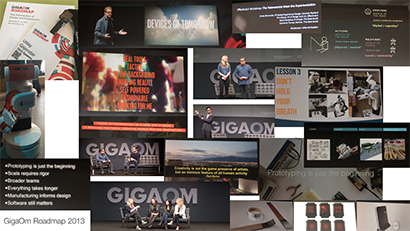
Conf Recap: GigaOm Roadmap 2013

Thanks to a friend, I snagged a free pass to attend this very cool 2-day conference in downtown SF called Roadmap 2013 run by GigaOm (Om Malik’s eponymous blogging and research outfit) focused on intersections of UX & technology, with a veritable rockstar lineup from the current tech scene. One track, with lots of presentations, on-stage interviews, and even some fun robots! Below are my main takeaways and notes. Enjoy…


Gigaom collage flat mini


Day ONE

The event kicked off with a bang in terms of a one-by-one series of major headliner speakers!

* Robert Brunner: Head of Ammunition design and co-maestro of Beats brand/products, he itemized what he’d like to see in coming years– Smart tools (like Adobe Mighty & Napoleon concepts), Self-charging devices (ReGen concepts), Smart appliances (iPhone wake-up alarm triggers coffee maker in kitchen), Smart watch (like Pebble, and beyond with fitness operations), and Wearables that “get” fashion. 

* John Maeda: Head of RISD, great talk on art + technology = design. “Design is how we balance less and more, it’s maddening but a worthwhile pursuit.” 

* Jack Dorsey: In on-stage interview, Jack described the founding of Square in terms of philosophy and principles behind the product experience and team dynamics. Some key points: “Show, don’t tell” is main operating principle at meetings. Always show prototypes. He wanted to create a product that you’d want to use everywhere, all the time. Square isn’t just about payments, it’s the total CX journey. You have to build the entire cohesive stack without seams, to enable discovery, decisions, exchanges. “Meet our customers where they are” became the tagline. Observed Sightglass (coffee house in SF) and used that to initially drive the CX journey, designing magical moments for the merchant too. (“offline merchant” analytics, like inventory). At the office, advocates “responsible transparency”, where everyone in the co has access to all team meeting notes, no secrets. 

Couple great quotes from Jack Dorsey:

— “A company that regenerates is not dependent on one person.” (hence the all-share of notes, wide open spaces, allowing serendipitous moments, hearing stuff that changes minds, etc.)

— “Great design and engineering is breaking a complex problem into smaller simpler, sequential bits.” Takes execution and patience to deliver. 

 * Erik Spiekerman: This legendary (and hilariously curmudgeonly) type designer spoke about type design for screen, and his experiments with open source fonts via Fira for Mozilla. Said typography is not an economic engine, but for cultural and superfluous reasons. Criticized iOS 7 typography as “folly of youth”. Compared Helvetica to table salt, so ubiquitous and used to flavor something bland. About design at-large, he said: “Designing takes a degree of modest I’m not known for” ;-)  BTW, the difference between typeface and font: “You design a typeface, and you buy a font.”–the analogy is like writing a song but buying a track on iTunes. Hmm! Designers are needed to make this a nicer, easier place…and “we’re paid to make things look good”, meaning it’s a wonderful job!

* Tony Fadell (Nest CEO): I can totally see this guy arguing with Steve and Scott and Jony back at Apple! Very ebullient effusive speaker, full of energy and optimism. Just like Brunner and Dorsey he emphasized designing the “full stack”, from top to bottom. Can’t ship a product without all the pieces in full play; design is just one part. But having a great UX is the starting point, period. Raised a couple interesting points:

— “Just because things can be connected doesn’t mean they should be. You gotta reinvent devices with connection built-in.” citing his own Nest thermostat and iPhone pairing as naturally tied together for a truly connected lifestyle. 

— Described “data-driven magical moments”: Magical moments for Fadell involve finding the right balance of rational and emotional thinking, and critical moments based upon data to tell you where to add delight. For Nest, they analyzed thermostat data from customers (time of day, temps, adjustments, frequency of change, levels of change, contextual incidents like weather change, leave/enter house). See how thermostat changes shaped behaviors of users, energy consumption rates, etc. Mined the data, identified patterns. But still gotta consider the “whole lifetime of the product”, how lives in person’s life. Contextual info over time, adds to value and delight. 

 * XBOX One Creative Director: Described design process, emphasizing the “architectural” approach of building something of value. “A minimal simple statement”. The controller had to fit a wide range of hands, did over 200 models. Analyzed “grip architectures” for various thumb and hand positions for different game genres (racing, shooter, RPG, collab, etc.) Said the One is “hi-def branded hardware” with a more cohesive branding scheme that fits the simplified Metro style too. 

* Reinventing Maps for Data-rich Web: This on-stage interview featured two of Google Maps head designers/engineers. Reflected upon how in 2004 Google Maps was novel for being able to drag/pan the map directly. Now, it’s all about personalized data based upon your Google account, recommendations, friends activity. Very data-intensive approach enabling “proximity semantics”, giving you a map that ‘s just for you, and feels “alive”, adaptive to real-time data. Becomes a “canvas you care about” for your needs, not just finding a place, but living and discovering the context over time and place. According to them: “Our biggest competitor is the real world.” Big ambitions! 

* Panel: Telemtrists vs Experientialists– This was a fun panel pitting data scientists against user experience leaders. Of course it all intersects, there’s a dance of data and intuition. But one key point: “Big Data is like Big Oil–it’s raw and unrefined.” Need methods, lenses, interpretations to transform the raw data into meaningful value for decisions and experiences. Must answer the question: What are you working towards first. Then see how “big data” can help you.

* Crowdfunding panel: Fairly mundane. Few key points:

— Know the investors objectives (VC’s as well as crowd funders)
— Build a story and relationships over time
— Always remember the 4 P’s of crowd funding: passion, people, participation, perks 


Day TWO

Unfortunately I had to miss the morning sessions due to work commitments. However I did catch a few of the late afternoon sessions.

* Rise of the Designer Founder: Loved this very fascinating on-stage interview with Joe Gebbia of Airbnb. Very authentic and heartfelt, you can tell Joe is quite the humble/modest designer (RISD grad) with aims of reinventing the online rental experience, while making it friendly and useful around the world. Advocated the total “end-to-end” customer experience. Transformed an initial 8-step purchase process to just 3 clicks (search > listings > book it). Realized building trust with a talented team is hard work. Joe definitely gets design: he took his team to the Eames house in L.A. for inspiration. The startup process was difficult yet upbeat–He said “every rejection by an investor was an invitation to keep going” (very positive attitude, also naively curious what’s next). He saw “rejection in its purest form” when harshly told Airbnb was a “crazy idea”. Lived through it, now a hero of sorts for designer-founders.

* Emotional Design for E-commerce: Finally an all-women panel at a tech conference! #progress The conversation was around the evolution of emotional UX for “e-commerce” (wow, I haven’t heard that word used in a decade ;-) The idea isn’t enough, you gotta nail the digital experience in terms of craft and also answering customer desires/needs of fulfilling their purchase goals…while still delivering a community gateway to peers, recommendations, delightful surprises. 

* Is Software the New Black: This seems oddly titled, but basically a conversation with Samsung’s SVP of Media Solutions. Some light jabs about “copying UX” that fell flat (hinting the Apple lawsuits). Best line: “Software is the magic holding together a cross-device ecosystem. You gotta nail it.”  Hmm, sounds like something Steve Jobs would say ;-)

* Favorite UX in Tech: This fun panel capping the 2-day event surveyed various designers’ and engineers’ favorite UX examples: Square card reader, Makerbot, Uber, Amazon Prime, Automatic (a device for reading your car’s diagnostics on iPhone), Fitbit devices, Chromecast, Netflix, Rdio, Letterpress, Google Maps.Â